A Levels Biology (9700)•9700/11/O/N/23
A Levels Biology (9700) — 9700/11/O/N/23, Question 25
Sickle cell anemia is caused by a mutation in an allele of the gene that codes for β-globin. The diagram shows the HbA (normal) and HbS (sickle cell) β-globin alleles. Of the template strand of DNA for both HbA and HbS: HbA 3' CTG ACT GAG GAG AAG TCT 5' HbS 3' CTG ACT GAG GAG GTG TCT 5'. Both β-globin mRNAs are the same length. Which of the following explains how the mutation in the HbS allele results in the production of an altered version of β-globin?
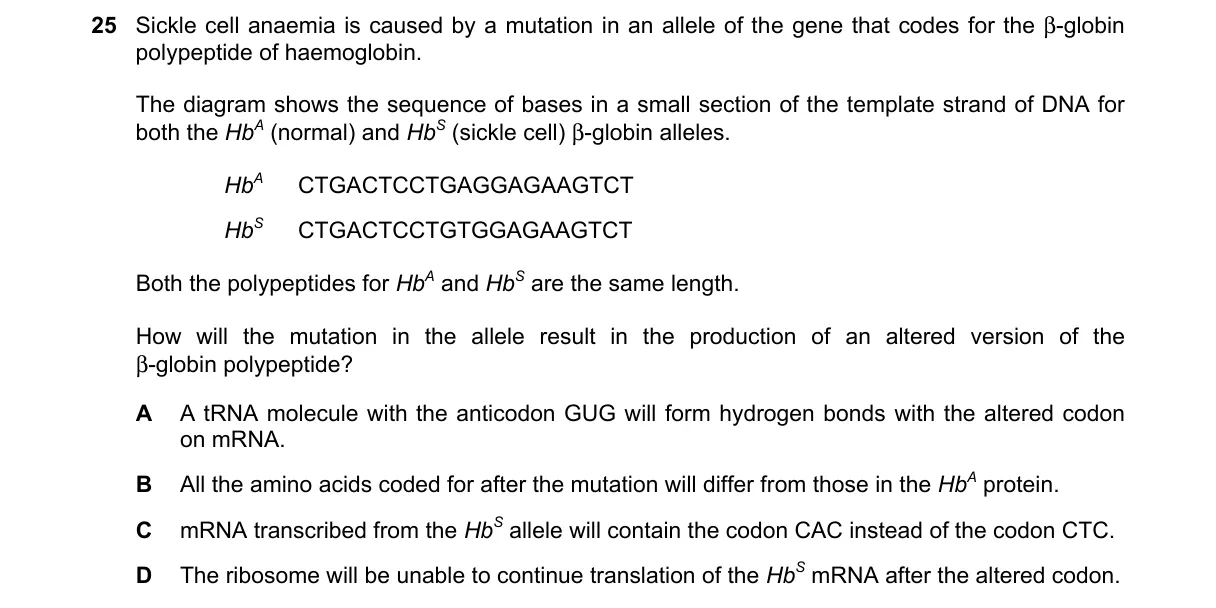
Answer choices
- AAn RNA molecule with the anticodon GUG will hydrogen bond with the altered codon
- BThe mRNA transcribed from the HbS allele will contain the codon CAC instead of the HbA codon CTC.
- CAll transcripts from HbS allele contain CAC instead of codon CTC.
- DThe ribosome will be unable to continue translation of the HbS mRNA after the altered codon.
Explanation
DNA mutation alters mRNA codon, enabling different tRNA binding for amino acid substitution Steps:
- Compare template strands: HbS differs from HbA in the triplet (GTG vs. AAG), a point mutation affecting transcription.
- Transcribe to mRNA: The HbS template produces an altered codon complementary to 3'-GTG-5' (5'-CAC-3' in mRNA).
- Analyze translation: The changed mRNA codon pairs with a specific tRNA anticodon via complementary base pairing.
- Determine protein impact: Different tRNA binding incorporates a nonstandard amino acid, yielding altered β-globin while maintaining mRNA length.
Why A is correct:
- It describes complementary hydrogen bonding between the altered codon and tRNA anticodon GUG, incorporating a different amino acid per the genetic code's missense mutation rule.
Why the others are wrong:
- B: States the codon change but fails to explain how it alters the protein (no link to tRNA or amino acid).
- C: Repeats B's codon description with unnecessary "all transcripts" detail, without mechanistic explanation.
- D: Falsely implies the mutation creates a stop codon halting translation; it is a missense mutation allowing continuation.
Final answer: A
Topic: Protein synthesis
Practice more A Levels Biology (9700) questions on mMCQ.me