A Levels Biology (9700)•9700/11/O/N/23
A Levels Biology (9700) — 9700/11/O/N/23, Question 23
Bacteria were grown in a medium containing 15N. After several generations, all of the bacterial DNA contained only 15N. The bacteria were then allowed to divide once in a medium containing 14N and no 15N. This DNA was all hybrid DNA containing equal amounts of 15N and 14N. The remaining bacteria were allowed to divide one more time in the medium with 14N. The DNA of some bacteria was extracted and analyzed. What is the percentage of hybrid DNA?
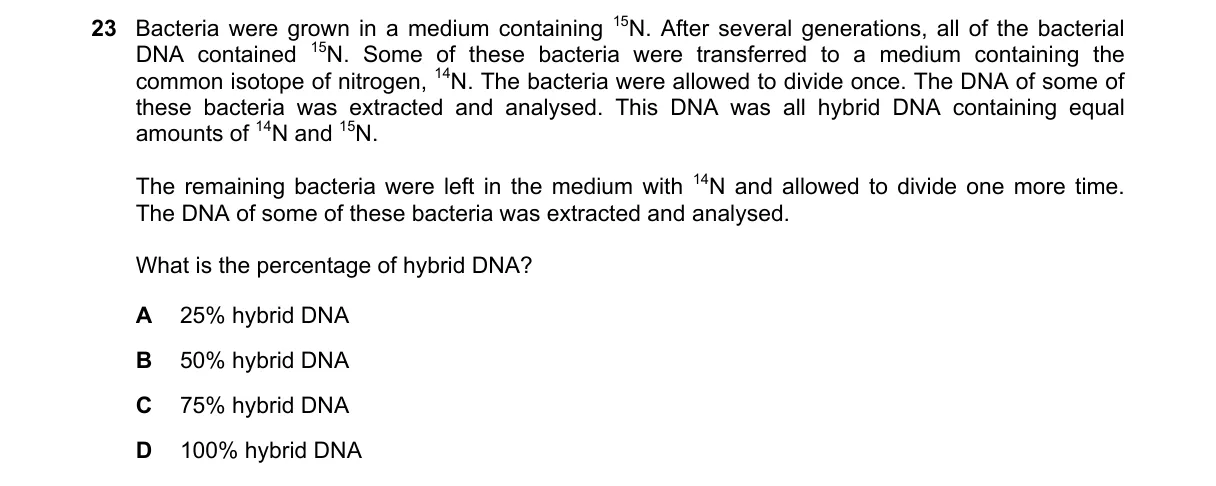
Answer choices
- A25% hybrid DNA
- B50% hybrid DNA
- C75% hybrid DNA
- D100% hybrid DNA
Explanation
Semi-conservative DNA replication in Meselson-Stahl experiment
Steps:
- Start: All bacterial DNA is heavy (15N/15N).
- After first division in 14N: Each DNA molecule unwinds; each strand pairs with 14N, yielding 100% hybrid (15N/14N) DNA.
- After second division in 14N: Each hybrid replicates; one daughter is hybrid (15N/14N), the other is light (14N/14N), so total DNA is 50% hybrid and 50% light.
- Extracted DNA from this population shows 50% hybrid molecules.
Why B is correct:
- Semi-conservative replication ensures each new molecule retains one parental strand, yielding exactly 50% hybrid DNA after two generations in light medium.
Why the others are wrong:
- A: 25% hybrid occurs after three generations, when light DNA predominates further.
- C: 75% hybrid mismatches the equal segregation of strands, producing only 50% hybrid.
- D: 100% hybrid is the result after just one generation.
Final answer: B
Topic: Structure of nucleic acids and replication of DNA
Practice more A Levels Biology (9700) questions on mMCQ.me