A Levels Biology (9700)•9700/11/O/N/23
A Levels Biology (9700) — 9700/11/O/N/23, Question 20
The statements are about genes and proteins involved in breast cancer. • The protein coded by the BRCA1 gene inhibits growth in breast cancer cells. • The protein coded by the p53 gene suppresses tumours in breast cancer cells. Which combination of genes is most likely to result in breast cancer?
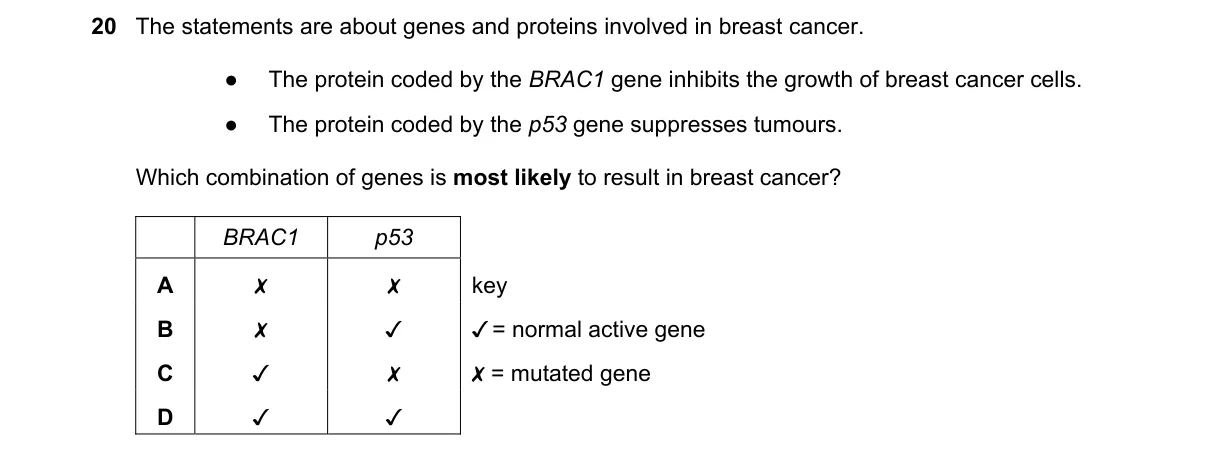
Answer choices
- ABRCA1: x, p53: x (x = normal active gene)
- BBRCA1: x, p53: x (normal active gene)
- CBRCA1: x, p53: x (normal gene)
- DBRCA1: ✓, p53: ✓ (mutated gene)
Explanation
Tumor Suppressor Genes and Cancer Risk
Steps:
- BRCA1 protein normally inhibits breast cancer cell growth; p53 suppresses tumors.
- Mutations inactivate these tumor suppressors, allowing uncontrolled cell proliferation.
- Breast cancer requires loss of function in both genes for high risk.
- Option A shows both genes as inactive (x = mutated/inactive).
Why A is correct:
- Per the two-hit hypothesis, biallelic inactivation of tumor suppressors like BRCA1 and p53 removes growth controls, directly causing cancer predisposition.
Why the others are wrong:
- B: One normal gene retains partial suppression, reducing cancer likelihood.
- C: Normal genes fully inhibit growth and tumors, preventing cancer.
- D: Mutated label unclear, but implies active function, not leading to cancer.
Final answer: A
Topic: Gene control
Practice more A Levels Biology (9700) questions on mMCQ.me