A Levels Biology (9700)•9700/11/O/N/23
A Levels Biology (9700) — 9700/11/O/N/23, Question 12
The specific heat capacity of different substances is shown. substance specific heat capacity (J/g°C) air 1.0 water (liquid) 4.3 water (steam) 2.1 Which statement
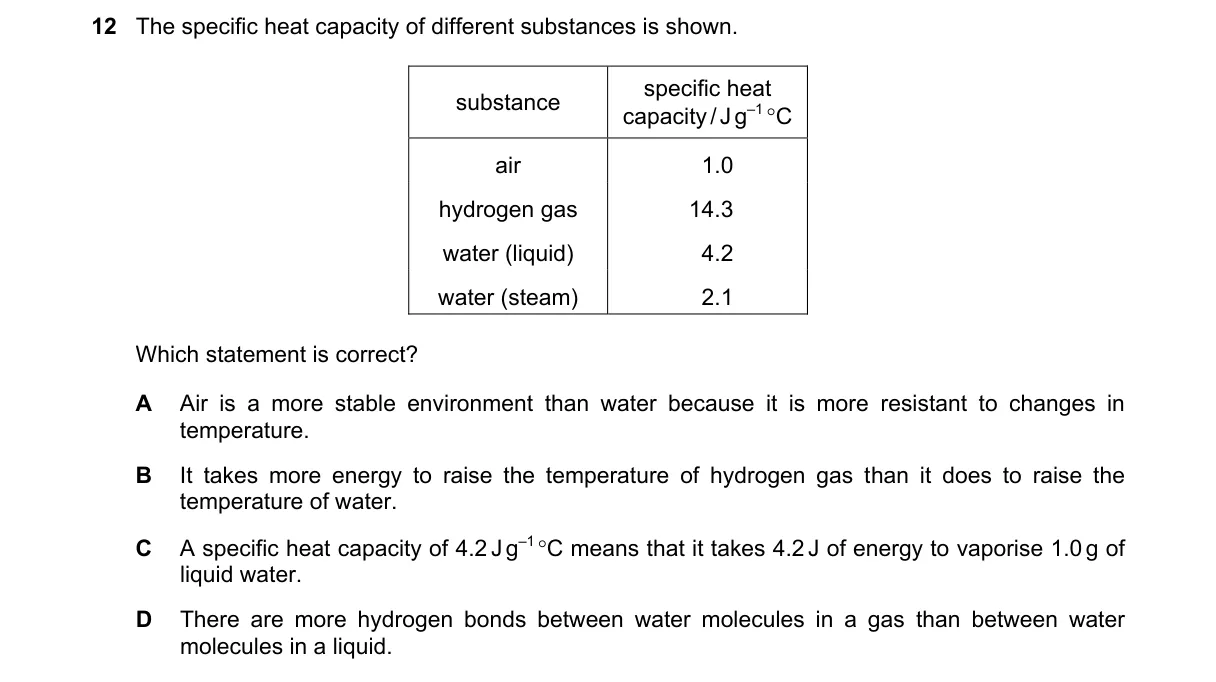
Answer choices
- AAir is a more stable environment than water because it is more resistant to changes in
- BIt takes more energy to raise the temperature of hydrogen gas than it does to raise the
- CA specific heat of 4.2 J/g°C means that it takes 4.2 J of energy to vaporise 1.0 g of
- DThere are more hydrogen bonds between water molecules in a gas than between water molecules in a liquid.
Explanation
Specific heat capacity measures thermal inertia
Steps:
- Define specific heat capacity as energy (J) needed to raise 1 g of substance by 1°C.
- Compare given values: air (1.0 J/g°C) requires less energy than liquid water (4.3 J/g°C) or steam (2.1 J/g°C).
- Recall hydrogen gas specific heat is ~7.15 J/g°C (from molar heat capacity 14.3 J/mol°C divided by 2 g/mol).
- Conclude B is true since 7.15 > 4.3, needing more energy for hydrogen than water.
Why B is correct:
- By definition, higher specific heat (c = Q / (m ΔT)) means more heat Q for same mass m and ΔT, and hydrogen's c exceeds water's.
Why the others are wrong:
- A: Air's low c (1.0) makes it less resistant to temperature changes than water's high c (4.3).
- C: Specific heat applies to temperature rise, not phase change like vaporization (latent heat).
- D: Gas phase (steam) has fewer hydrogen bonds than liquid water, explaining lower c for steam.
Final answer: B
Topic: Water
Practice more A Levels Biology (9700) questions on mMCQ.me