A Levels Biology (9700)•9700/13/O/N/22
A Levels Biology (9700) — 9700/13/O/N/22, Question 9
The diagram represents part of an alginic acid molecule. Alginic acid is a polymer found in the cell walls of brown seaweeds. Which statement about alginic acid is correct?
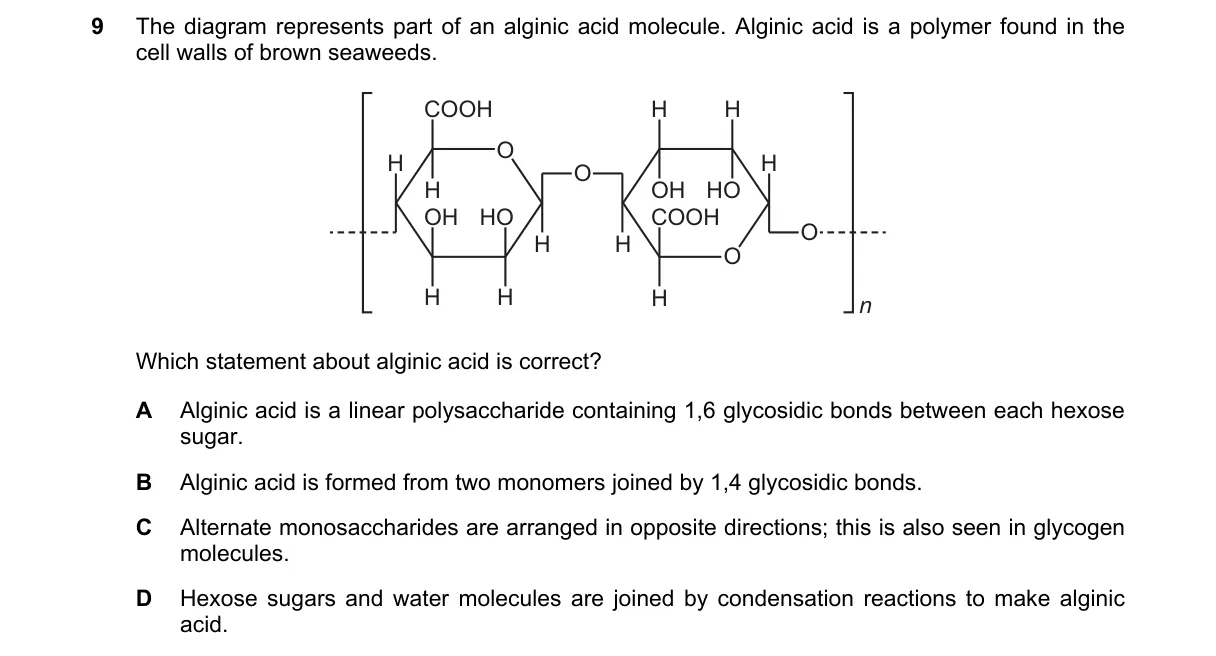
Answer choices
- AAlginic acid is a linear polysaccharide containing 1→6 glycosidic bonds between each hexose
- BAlginic acid is formed from two monosaccharides arranged in opposite directions; this is seen in glycogen
- CHexose sugars and water molecules are joined by condensation reactions to make alginic acid
- DAlginic acid is formed from two monomers joined by 1→4 glycosidic bonds between each hexose
Explanation
Alginic Acid's Block Copolymer Structure
Steps:
- Identify alginic acid as a linear polysaccharide from brown seaweed cell walls, composed of mannuronic and guluronic acid units.
- Note the diagram likely shows alternating or block arrangements of these two uronic acid monosaccharides.
- Recognize that the polymer features regions where the two sugars link in sequences with differing stereochemistry, resembling opposed orientations.
- Compare to options, eliminating those mismatched to known 1→4 β-glycosidic bonds and linear form.
Why B is correct:
- Alginic acid consists of β-D-mannuronic and α-L-guluronic acids in block or alternating sequences, creating opposite directional arrangements along the chain, unlike uniform glycogen.
Why the others are wrong:
- A: Bonds are 1→4, not 1→6; it's not solely hexose-based without uronic modifications.
- C: Involves only uronic acid monomers via glycosidic bonds, not hexoses and water directly.
- D: While 1→4 bonds are present, it requires two specific uronic monomers, not generic ones.
Final answer: B
Topic: Carbohydrates and lipids
Practice more A Levels Biology (9700) questions on mMCQ.me