A Levels Biology (9700)•9700/13/O/N/22
A Levels Biology (9700) — 9700/13/O/N/22, Question 4
Which row is correct for typical prokaryotic and mitochondrial cells?
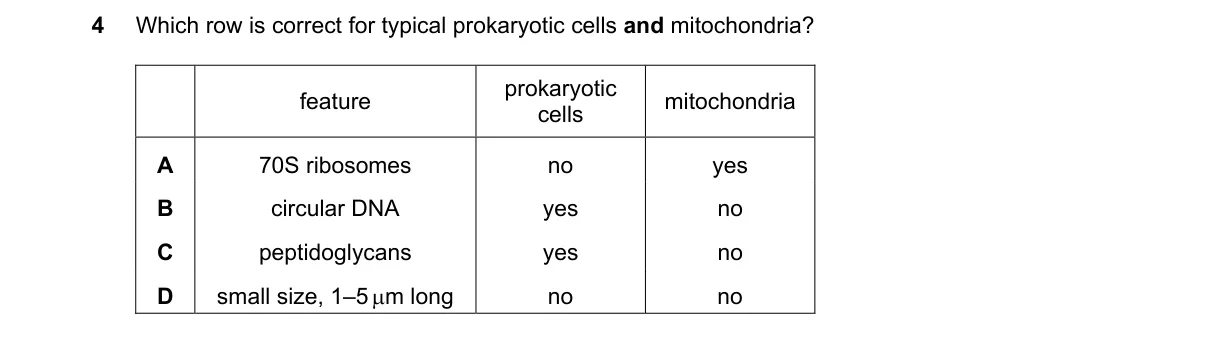
Answer choices
- A70S ribosomes: prokaryotic no, mitochondrial yes
- Bcircular DNA: prokaryotic yes, mitochondrial no
- Cpeptidoglycan: prokaryotic yes, mitochondrial no
- Dsmall 1-10 μm long: prokaryotic no, mitochondrial no
Explanation
Distinguishing prokaryotic vs. mitochondrial features
Steps:
- List prokaryotic traits: 70S ribosomes, circular DNA, peptidoglycan wall, 1-10 μm size.
- List mitochondrial traits: 70S ribosomes, circular DNA, no peptidoglycan, 0.5-2 μm size.
- Compare each choice to these traits for accuracy.
- Select the choice correctly stating prokaryotic yes, mitochondrial no.
Why C is correct:
- Peptidoglycan defines bacterial cell walls in prokaryotes; mitochondria, as endosymbiotic organelles, lack cell walls and thus peptidoglycan.
Why the others are wrong:
- A: Both prokaryotes and mitochondria contain 70S ribosomes for protein synthesis.
- B: Both have circular DNA genomes, reflecting prokaryotic ancestry of mitochondria.
- D: Prokaryotes measure 1-10 μm (yes), but mitochondria are smaller (no); option incorrectly states no for both.
Final answer: C
Topic: Cells as the basic units of living organisms
Practice more A Levels Biology (9700) questions on mMCQ.me