A Levels Biology (9700)•9700/13/O/N/22
A Levels Biology (9700) — 9700/13/O/N/22, Question 38
Certain bacteria develop resistance to an antibiotic by actively transporting the antibiotic out of the cell. This prevents the antibiotic building up to toxic concentrations. What must be found in a bacterial cell to allow it to develop this form of antibiotic resistance?
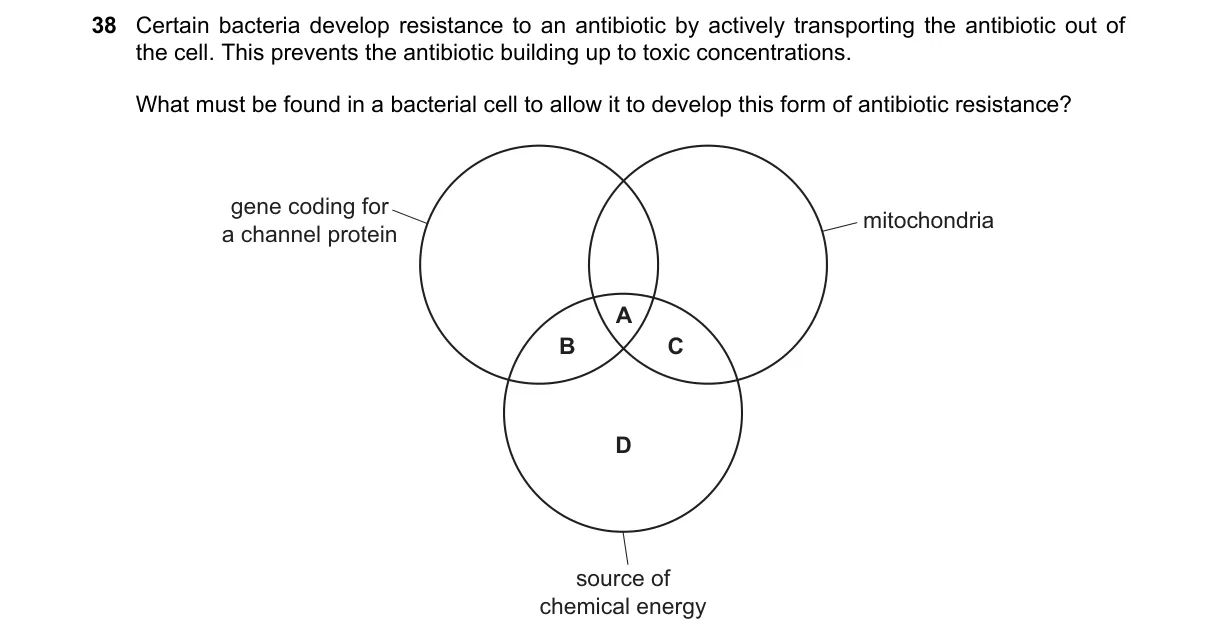
Answer choices
- Aa gene coding for a channel protein
- Bsource of chemical energy
- Cmitochondria
- DOption D
Explanation
Active transport via efflux pumps requires specific genetic machinery
Steps:
- Recognize the mechanism: antibiotic resistance via active transport out of the cell, which moves substances against concentration gradients.
- Recall active transport definition: uses energy to power membrane proteins called pumps, not passive channels.
- Identify bacterial requirements: cells need genes to produce these pump proteins for efflux.
- Eliminate unrelated options: bacteria lack organelles like mitochondria and rely on chemical energy sources already present.
Why D is correct:
- D (gene coding for a pump protein) enables synthesis of efflux pumps, essential for active transport per the definition of carrier-mediated transport against gradients.
Why the others are wrong:
- A: Channel proteins facilitate passive diffusion, not energy-dependent active transport.
- B: Chemical energy (e.g., ATP) is necessary but insufficient alone; specific pump proteins are required for the mechanism.
- C: Bacteria are prokaryotes without mitochondria, which generate energy in eukaryotes.
Final answer: D
Topic: Antibiotics
Practice more A Levels Biology (9700) questions on mMCQ.me