A Levels Biology (9700)•9700/13/O/N/22
A Levels Biology (9700) — 9700/13/O/N/22, Question 13
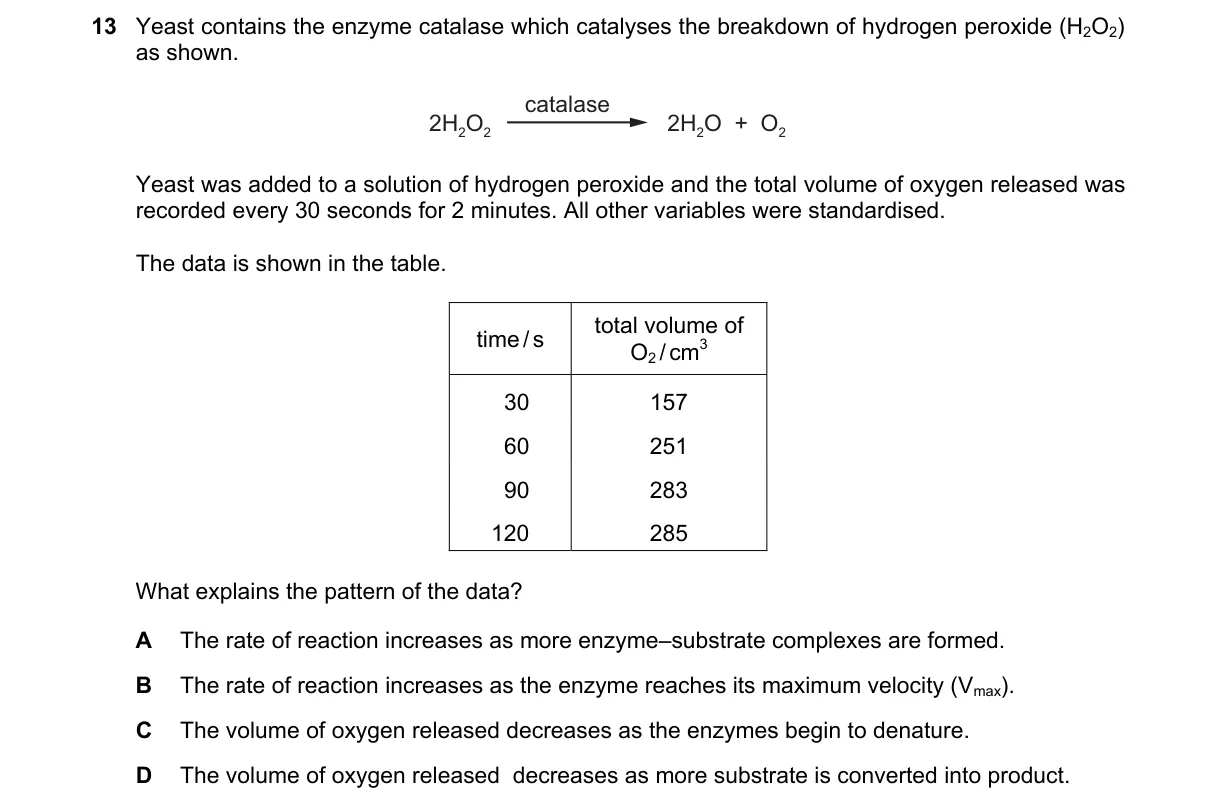
Yeast contains the enzyme catalase which catalyses the breakdown of hydrogen peroxide (H2O2) as shown.
H2O2 catalase → H2O + O2
Yeast was added to a solution of hydrogen peroxide and the total volume of oxygen released was recorded every 30 seconds for 4 minutes. All other variables were standardised.
The data is shown in the table.
Time (s) | Total vol of O2 (cm³)
30 | 15
60 | 251
90 | 285
What explains the pattern of the data?
Answer choices
- AThe rate of reaction increases as the enzyme reaches its maximum velocity (Vmax).
- BThe volume of oxygen released decreases as the enzyme begins to denature.
- CThe rate of reaction increases as more enzyme-substrate complexes are formed.
- DThe volume of oxygen released decreases as more substrate is converted into product.
Explanation
Substrate Depletion Slows Reaction Rate
Steps:
- Examine data: Total O₂ rises from 15 cm³ at 30 s to 251 cm³ at 60 s (236 cm³ increase), then to 285 cm³ at 90 s (34 cm³ increase).
- Calculate rate: Initial rate high (236 cm³/30 s), then slows (34 cm³/30 s), showing decreasing production.
- Identify pattern: Cumulative volume increases but at diminishing rate, indicating substrate (H₂O₂) limits reaction.
- Link to enzyme kinetics: As substrate converts to products, fewer molecules available, reducing enzyme-substrate complexes and rate.
Why D is correct:
- In enzyme-catalyzed reactions, rate decreases when substrate concentration falls (Michaelis-Menten kinetics), as less substrate means fewer complexes form, slowing product (O₂) formation.
Why the others are wrong:
- A: Rate decreases, not increases toward Vmax; Vmax is maximum rate at saturating substrate.
- B: Total O₂ volume increases overall; denaturation would halt reaction entirely.
- C: Rate decreases, not increases; complex formation declines with substrate depletion.
Final answer: D
Topic: Factors that affect enzyme action
Practice more A Levels Biology (9700) questions on mMCQ.me