A Levels Biology (9700)•9700/13/O/N/22
A Levels Biology (9700) — 9700/13/O/N/22, Question 12
Some molecules fluoresce when illuminated with ultraviolet light. Changes in the structure or shape of such molecules can change the intensity of the fluorescence. The enzyme tryptophan synthase fluoresces bluish-green because of a phosphate group associated with the active site. Serine + indole → tryptophan Adding serine to the enzyme increases the intensity of the fluorescence, but when indole is also added, the bluish-green fluorescence decreases in intensity. What may be concluded from these observations? 1 Serine and indole attach to the active site of the enzyme. 2 An enzyme-serine complex is formed. 3 An enzyme-serine-indole complex is formed.
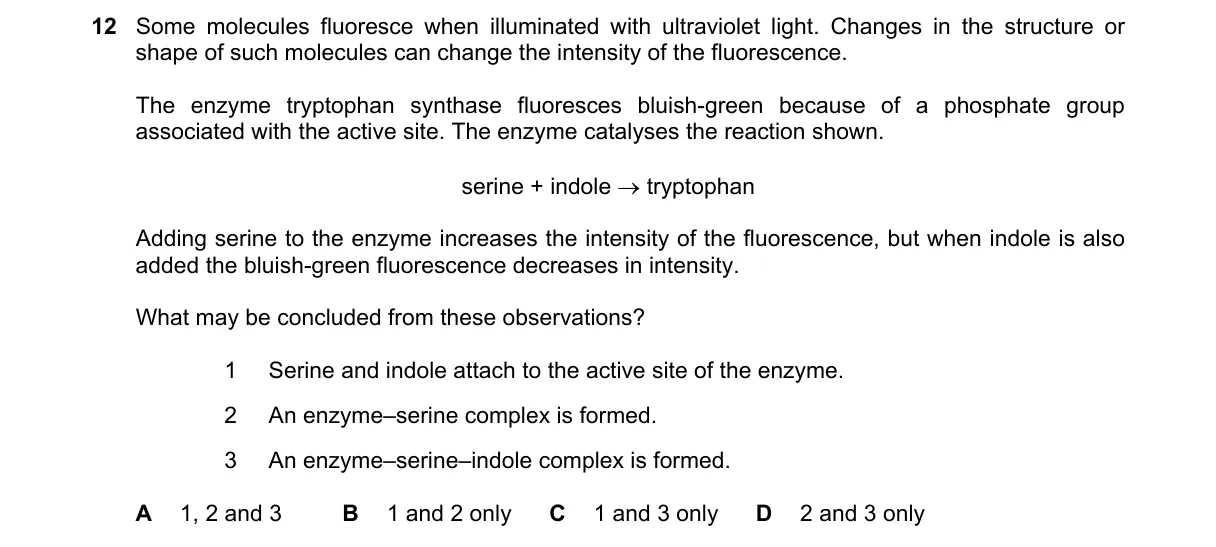
Answer choices
- A1, 2 and 3
- B1 and 2
- C1 and 3 only
- D2 and 3 only
Explanation
Fluorescence Indicates Substrate Binding
Steps:
- Enzyme fluoresces due to phosphate group; structural changes alter intensity.
- Serine addition increases fluorescence, indicating serine binds to enzyme, forming enzyme-serine complex (supports 2).
- Indole addition with serine decreases fluorescence, indicating indole binds to enzyme-serine complex, forming enzyme-serine-indole complex (supports 3).
- Reaction (serine + indole → tryptophan) and fluorescence changes confirm both substrates attach at active site (supports 1).
Why A is correct:
- All observations align with enzyme kinetics: binary complex enhances fluorescence, ternary complex quenches it, confirming active site binding.
Why the others are wrong:
- B omits 3; decrease with indole shows ternary complex formation.
- C omits 2; increase with serine shows enzyme-serine complex.
- D omits 1; substrates' role in reaction ties binding to active site.
Final answer: A
Topic: Mode of action of enzymes
Practice more A Levels Biology (9700) questions on mMCQ.me