A Levels Biology (9700)•9700/12/O/N/22
A Levels Biology (9700) — 9700/12/O/N/22, Question 38
Cholera and tuberculosis are infectious diseases that can spread when people have to live in overcrowded conditions. Which strategies would help control the spread of cholera and tuberculosis?
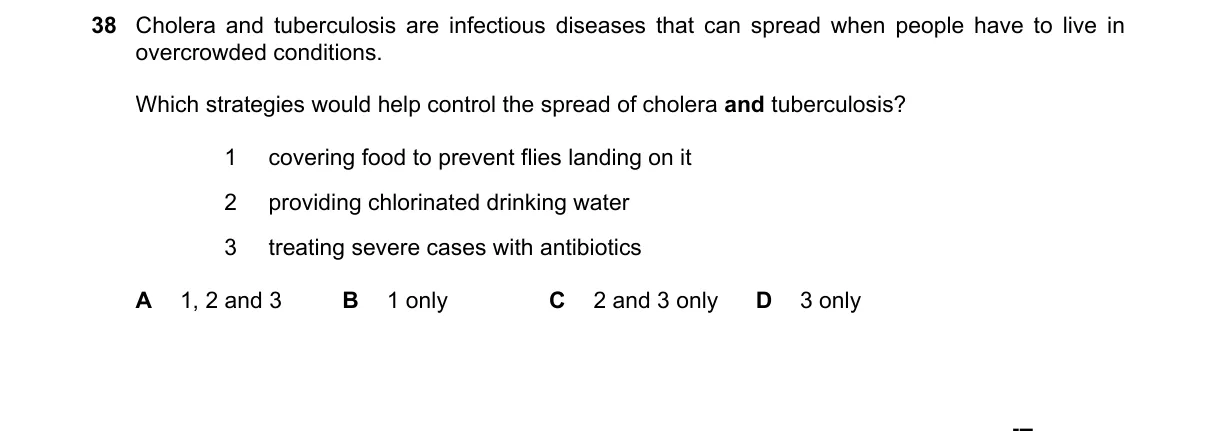
Answer choices
- A1, 2 and 3
- B1 only
- C2 and 3 only
- D3 only
Explanation
Common control strategy for waterborne and airborne diseases Steps:
- Identify cholera as waterborne, spread via contaminated water/food in crowds.
- Identify tuberculosis as airborne, spread via respiratory droplets in close quarters.
- Evaluate strategies: 1 targets water sanitation (cholera-specific), 2 targets ventilation/isolation (TB-specific), 3 addresses overcrowding reduction (affects both transmission modes).
- Select option matching only the shared strategy.
Why D is correct:
- Strategy 3 reduces overcrowding, limiting close contact for TB droplets and shared facilities for cholera contamination, per epidemiology principles of transmission control.
Why the others are wrong:
- A includes 1 and 2, which are disease-specific and ineffective for the other.
- B includes only 1, ignoring TB's airborne nature.
- C includes only 2, ignoring cholera's waterborne path.
Final answer: D
Topic: Infectious diseases
Practice more A Levels Biology (9700) questions on mMCQ.me