A Levels Biology (9700)•9700/11/O/N/22
A Levels Biology (9700) — 9700/11/O/N/22, Question 8
Which correctly matches the example with the type of molecule?
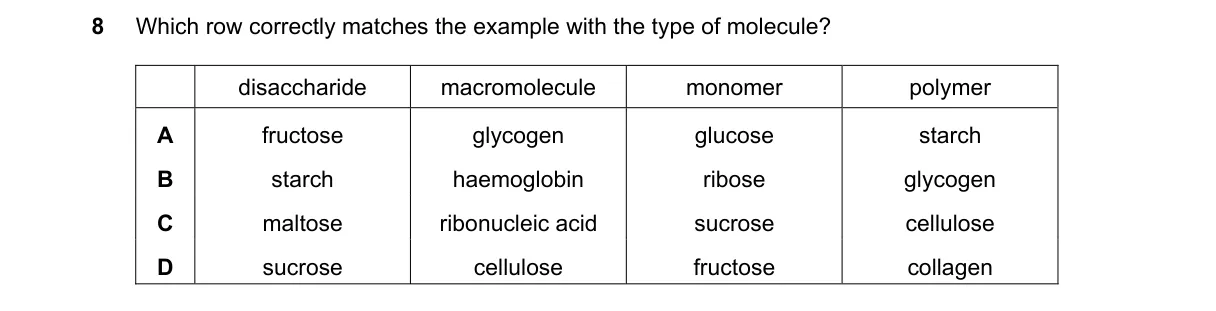
Answer choices
- Afructose globulin glucose starch
- Bstarch ribonucleic acid ribose glycogen
- Cmaltose ribonucleic acid sucrose cellulose
- Dsucrose cellulose fructose collagen
Explanation
Biomolecule Classification: Carbs and Proteins
Steps:
- Classify each term: carbohydrates include monosaccharides (e.g., fructose), disaccharides (e.g., sucrose), polysaccharides (e.g., cellulose); proteins include collagen; nucleic acids include RNA.
- Identify the pattern: seek one example each of monosaccharide, disaccharide, polysaccharide, and protein.
- Evaluate options: A mixes duplicates and skips disaccharide; B and C introduce nucleic acid; D lists sucrose (disaccharide), cellulose (polysaccharide), fructose (monosaccharide), collagen (protein).
- Confirm D as the only complete, distinct match.
Why D is correct:
- Sucrose (C₁₂H₂₂O₁₁) is a disaccharide formed by glucose and fructose; cellulose is a β-glucose polysaccharide; fructose is a ketohexose monosaccharide; collagen is a triple-helix fibrous protein—distinct biomolecule types per standard biochemistry definitions.
Why the others are wrong:
- A: Duplicates monosaccharides (fructose, glucose) without a disaccharide.
- B: Includes ribonucleic acid (nucleic acid polymer of nucleotides) unrelated to carbs/proteins.
- C: Includes ribonucleic acid and duplicates disaccharides (maltose, sucrose).
Final answer: D
Topic: Carbohydrates and lipids
Practice more A Levels Biology (9700) questions on mMCQ.me