A Levels Biology (9700)•9700/11/O/N/22
A Levels Biology (9700) — 9700/11/O/N/22, Question 36
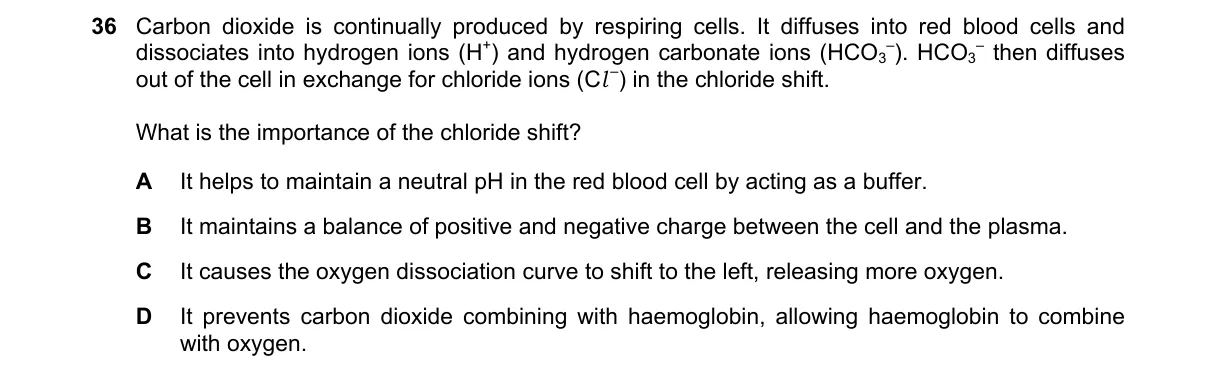
Carbon dioxide is continuously produced by respiring cells. It diffuses into red blood cells and diffuses out of the cells into the plasma. HCO3- then diffuses out of the cell in exchange for Cl- ions (chloride shift). What is the importance of the chloride shift?
Answer choices
- AWhat helps to maintain a neutral pH in the red blood cell by acting as a buffer.
- BIt maintains balance of positive and negative charge between the cell and the plasma.
- CIt prevents the oxygen dissociation curve shift to the left, releasing more oxygen.
- DIt causes the oxygen dissociation curve shift to the left, releasing more oxygen.
Explanation
Chloride Shift Maintains Electrical Neutrality
Steps:
- CO2 diffuses into red blood cells and converts to HCO3- via carbonic anhydrase.
- HCO3- diffuses out of the cell into plasma.
- Cl- ions enter the cell in exchange for HCO3- to balance charges.
- This anion exchange prevents charge imbalance across the membrane.
Why B is correct:
- It upholds Donnan equilibrium by exchanging anions (HCO3- out, Cl- in), maintaining equal positive and negative charges between cell interior and plasma.
Why the others are wrong:
- A: pH buffering occurs via hemoglobin binding H+, not the chloride shift.
- C: The shift does not affect the oxygen dissociation curve; left shift prevention relates to Bohr effect from pH changes.
- D: No direct causation of left shift; oxygen release ties to CO2/pH, not anion exchange.
Final answer: B
Topic: Transport of oxygen and carbon dioxide
Practice more A Levels Biology (9700) questions on mMCQ.me