A Levels Biology (9700)•9700/11/O/N/22
A Levels Biology (9700) — 9700/11/O/N/22, Question 35
Red cells may contain a molecule known as 2,3-bisphosphoglycerate (2,3-BPG). When 2,3-BPG binds to hemoglobin, a higher partial pressure of oxygen is needed to bring about 50% saturation of hemoglobin with oxygen. Binding of 2,3-BPG to hemoglobin lowers the affinity of hemoglobin for oxygen. When 2,3-BPG is not present, oxyhemoglobin is less likely to unload oxygen. Which statements about 2,3-BPG are correct? 1. 2,3-BPG in red cells causes the oxygen dissociation curve to shift to the right. 2. The binding of 2,3-BPG to hemoglobin reduces the Bohr effect. 3. When 2,3-BPG is not present, oxyhemoglobin is less likely to unload oxygen. 4.
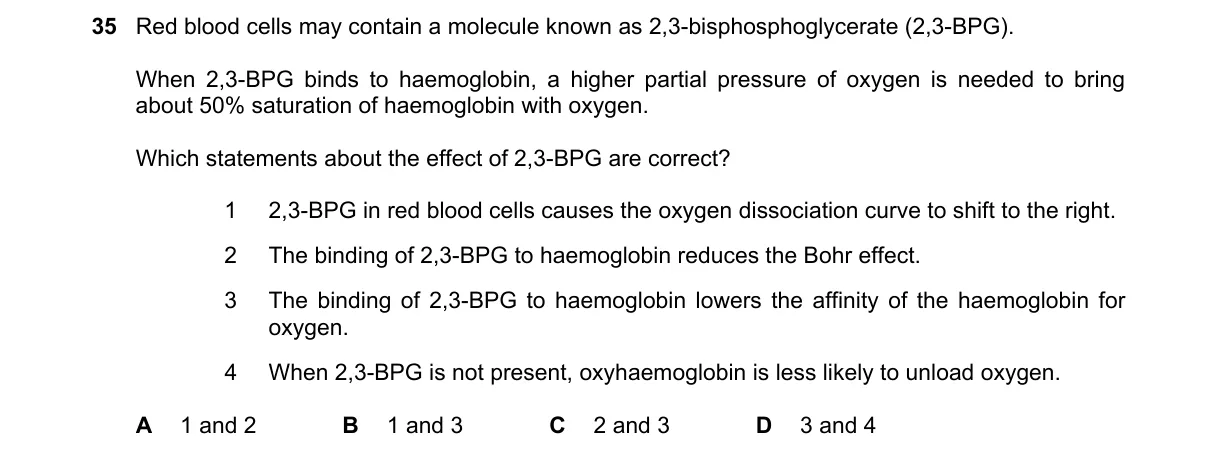
Answer choices
- A1 and 2
- B1 and 3
- C2 and 3
- D3 and 4
Explanation
2,3-BPG Shifts Oxygen Dissociation Curve Rightward
Steps:
- Statement 1 is correct: 2,3-BPG binds deoxyhemoglobin, stabilizing low-affinity T-state, increasing P50 and shifting curve right for easier tissue unloading.
- Statement 2 is incorrect: 2,3-BPG and Bohr effect (pH/CO2 influence) are independent allosteric modulators; 2,3-BPG does not reduce Bohr effect magnitude.
- Statement 3 is correct: Absent 2,3-BPG, hemoglobin affinity rises (left shift), making oxyhemoglobin hold oxygen tighter and unload less readily.
- Statement 4 lacks content, but option D pairs it with 3, implying 4 is false based on correct choice B.
Why B is correct:
- B pairs true statements 1 and 3, matching 2,3-BPG's role in reducing oxygen affinity per allosteric regulation principles.
Why the others are wrong:
- A includes false 2, ignoring 2,3-BPG's independence from Bohr effect.
- C pairs false 2 with true 3, misrepresenting effector interactions.
- D includes incomplete/false 4 with true 3, as verified by exclusion.
Final answer: B
Topic: Transport of oxygen and carbon dioxide
Practice more A Levels Biology (9700) questions on mMCQ.me