A Levels Biology (9700)•9700/11/O/N/22
A Levels Biology (9700) — 9700/11/O/N/22, Question 34
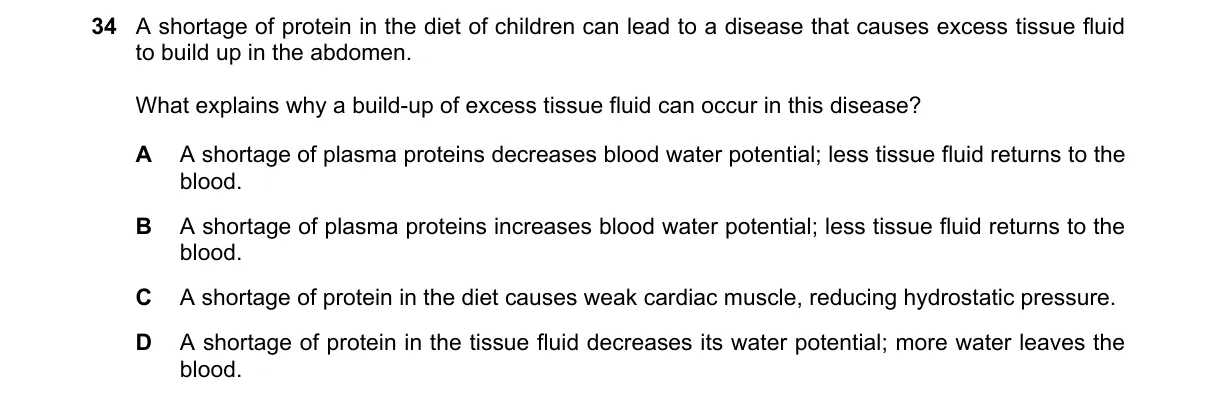
A shortage of protein in the diet of children can lead to a disease that causes excess tissue fluid to build up in the abdomen. What explains why a build-up of excess tissue fluid can occur in this disease?
Answer choices
- AA shortage of plasma proteins decreases blood water potential; less fluid returns to the blood.
- BA shortage of plasma proteins increases blood water potential; less fluid returns to the blood.
- CA shortage of protein in the tissue fluid decreases its water potential; more water leaves the blood.
- DA shortage of protein in the diet causes weak
Explanation
Low plasma proteins reduce osmotic pull, causing edema
Steps:
- Protein deficiency lowers plasma albumin, reducing colloid osmotic pressure in blood.
- This makes blood water potential less negative (higher) than in tissues.
- Fluid leaks out of capillaries into tissues but fails to return effectively.
- Excess fluid accumulates in abdomen, causing edema.
Why B is correct:
- Shortage of plasma proteins decreases solute concentration, raising blood water potential (ψ = ψ_s + ψ_p; less negative ψ_s means higher ψ), so less fluid re-enters via osmosis.
Why the others are wrong:
- A: Shortage actually increases (not decreases) blood water potential.
- C: Protein shortage affects plasma (not tissue fluid) water potential; more water leaves due to blood changes.
- D: Incomplete and irrelevant; diet shortage impacts plasma proteins, not directly causing weakness here.
Final answer: B
Topic: The circulatory system
Practice more A Levels Biology (9700) questions on mMCQ.me