A Levels Biology (9700)•9700/11/O/N/22
A Levels Biology (9700) — 9700/11/O/N/22, Question 26
The electron micrograph shows a cross-section of a leaf vein and some neighbouring cells. Which structure contributes to mass flow by the use of proton pumps?
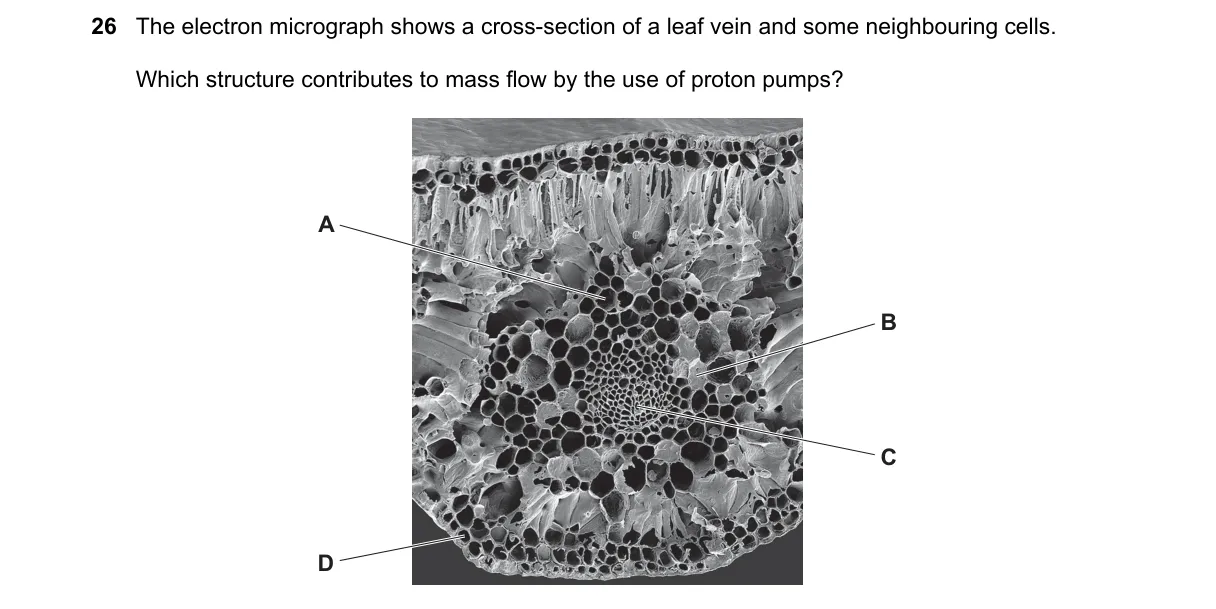
Answer choices
- AOption A
- BOption B
- COption C
- DOption D
Explanation
Proton pumps drive phloem loading for mass flow
Steps:
- Identify leaf vein structures: xylem for water, phloem for sugar transport via mass flow.
- Recall mass flow mechanism: pressure-flow hypothesis relies on active loading in phloem.
- Link proton pumps: H+-ATPases in companion cells create gradient for sucrose uptake.
- Match to micrograph: structure with proton pumps is companion cell in phloem.
Why C is correct:
- Companion cells use proton pumps (H+-ATPases) to acidify cytoplasm, enabling sucrose-H+ symport for phloem loading per pressure-flow model.
Why the others are wrong:
- A (xylem vessel): Passive water conduction, no proton pumps involved.
- B (sieve tube): Lacks organelles; relies on companion cells for loading, not direct proton pumping.
- D (mesophyll cell): Photosynthesis site, contributes sugars but no role in mass flow via pumps.
Final answer: C
Topic: Transport mechanisms
Practice more A Levels Biology (9700) questions on mMCQ.me