A Levels Biology (9700)•9700/11/O/N/22
A Levels Biology (9700) — 9700/11/O/N/22, Question 25
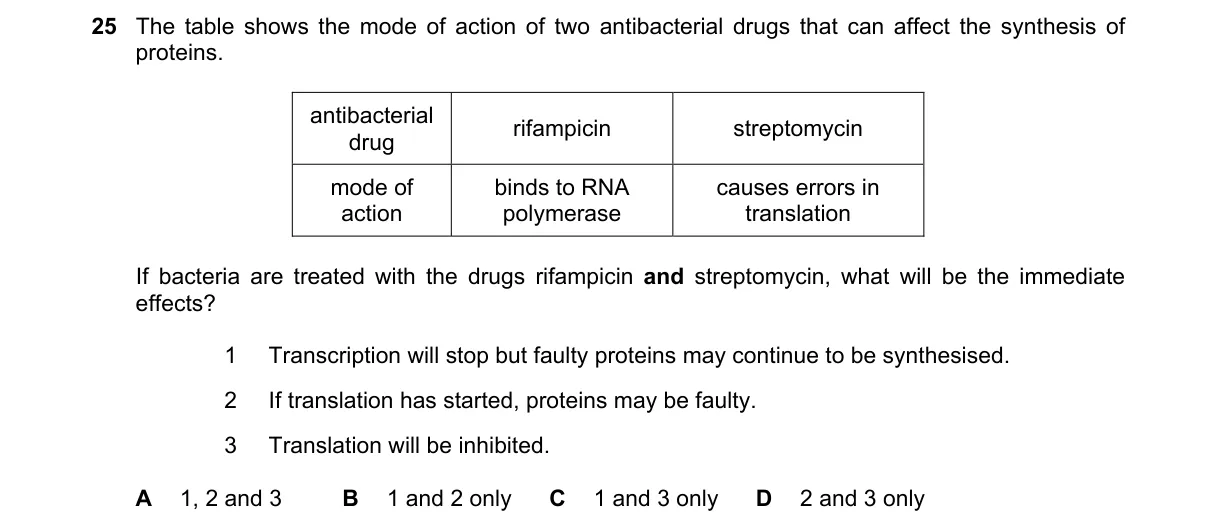
The table shows the mode of action of two antibiotics that can affect the synthesis of proteins. Antibiotic rifampin binds to RNA polymerase. Streptomycin causes errors in translation. If bacteria are treated with the drugs rifampin and streptomycin, what will be the immediate effects? 1 Transcription will stop, faulty proteins may be synthesized. 2 3 Translation will be inhibited.
Answer choices
- A1,2 and 3
- B1 and 2 only
- C1 and 3 only
- D2 and 3 only
Explanation
Combined effects of rifampin and streptomycin on bacterial protein synthesis
Steps:
- Rifampin binds to RNA polymerase, blocking transcription and preventing new mRNA synthesis.
- Streptomycin binds to the ribosome during translation, causing misreading of mRNA codons and producing faulty proteins.
- Immediate effect of rifampin: transcription stops, halting production of new mRNA.
- Immediate effect of streptomycin: translation of existing mRNA continues but generates erroneous proteins; translation is not fully inhibited.
Why B is correct:
- Rifampin inhibits transcription by binding RNA polymerase (per molecular biology definition of antibiotic mechanisms), while streptomycin induces translation errors without stopping it, matching effects 1 and 2.
Why the others are wrong:
- A includes 3, but streptomycin causes translation errors, not inhibition.
- C includes 3 but excludes 2, ignoring faulty protein synthesis from streptomycin.
- D excludes 1, overlooking rifampin's block of transcription.
Final answer: B
Topic: Protein synthesis
Practice more A Levels Biology (9700) questions on mMCQ.me