A Levels Biology (9700)•9700/13/O/N/21
A Levels Biology (9700) — 9700/13/O/N/21, Question 33
The diagram shows a magnified section of part of the lungs containing specialised tissues. Which row is correct for the structures labelled 1 to 6
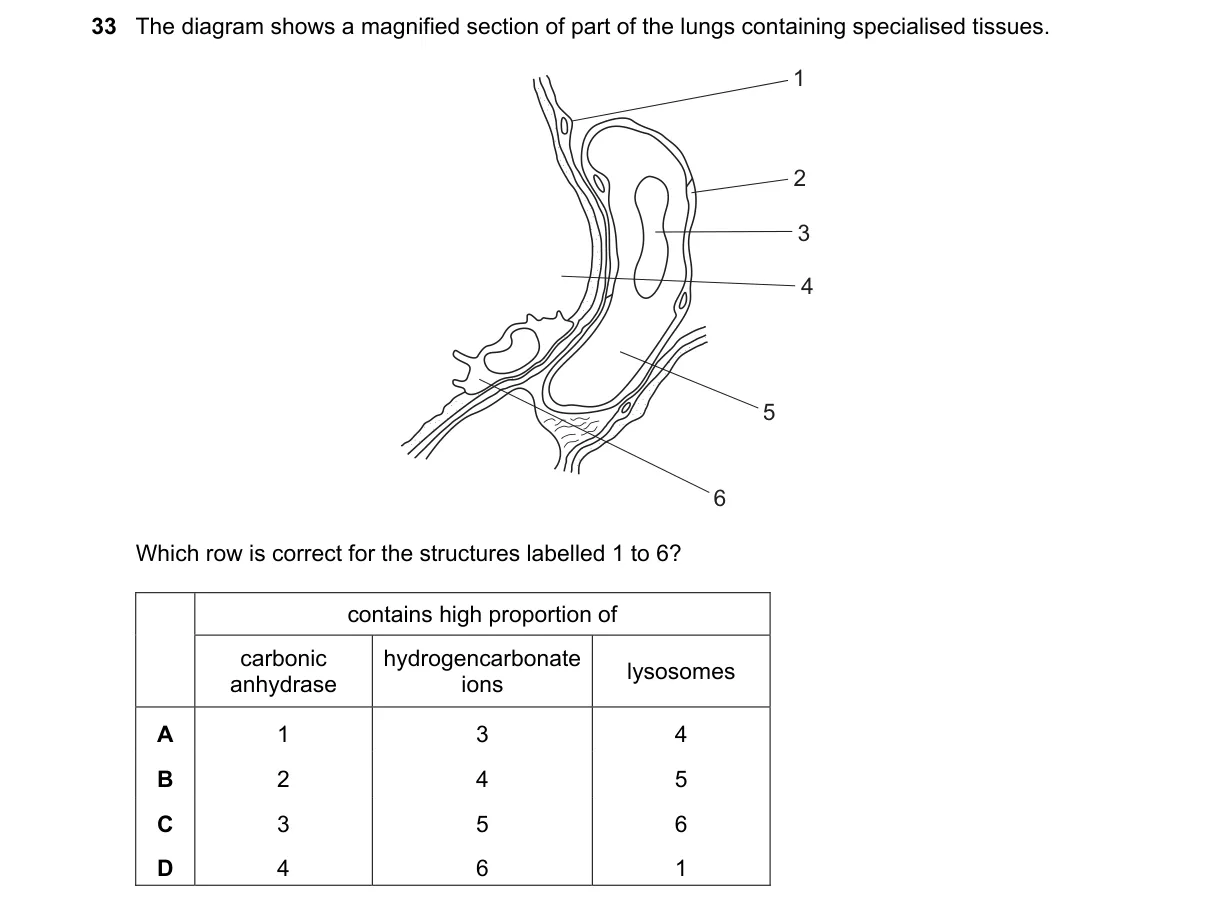
Answer choices
- Acarbonic anhydrase: 1, hydrogencarbonate: 3, lysosomes: 4
- Bcarbonic anhydrase: 2, hydrogencarbonate: 4, lysosomes: 5
- Ccarbonic anhydrase: 3, hydrogencarbonate: 5, lysosomes: 6
- Dcarbonic anhydrase: 4, hydrogencarbonate: 6, lysosomes: 1
Explanation
Matching lung structures to carbonic anhydrase, hydrogencarbonate, and lysosomes
Steps:
- Carbonic anhydrase enzyme is located in red blood cells within lung capillaries to convert CO2 into hydrogencarbonate for transport.
- Hydrogencarbonate ions form in red blood cells and diffuse into plasma for CO2 excretion in alveoli.
- Lysosomes are digestive organelles in alveolar macrophages that break down inhaled particles.
- Diagram labels: 3 identifies red blood cells, 5 shows plasma region, 6 points to macrophages.
Why C is correct:
- C assigns carbonic anhydrase to red blood cells (3), hydrogencarbonate to plasma (5), and lysosomes to macrophages (6), matching their biological roles in gas exchange and defense.
Why the others are wrong:
- A misplaces carbonic anhydrase (not 1), hydrogencarbonate (not 3), and lysosomes (not 4).
- B incorrectly locates carbonic anhydrase (not 2), hydrogencarbonate (not 4), and lysosomes (not 5).
- D wrongly assigns carbonic anhydrase (not 4), hydrogencarbonate (not 6), and lysosomes (not 1).
Final answer: C
Topic: Transport of oxygen and carbon dioxide
Practice more A Levels Biology (9700) questions on mMCQ.me