A Levels Biology (9700)•9700/13/O/N/21
A Levels Biology (9700) — 9700/13/O/N/21, Question 31
When active tissues have high carbon dioxide concentrations, oxyhaemoglobin needs to release oxygen to the tissues. How is the carbon dioxide transported away by the blood from the tissues?
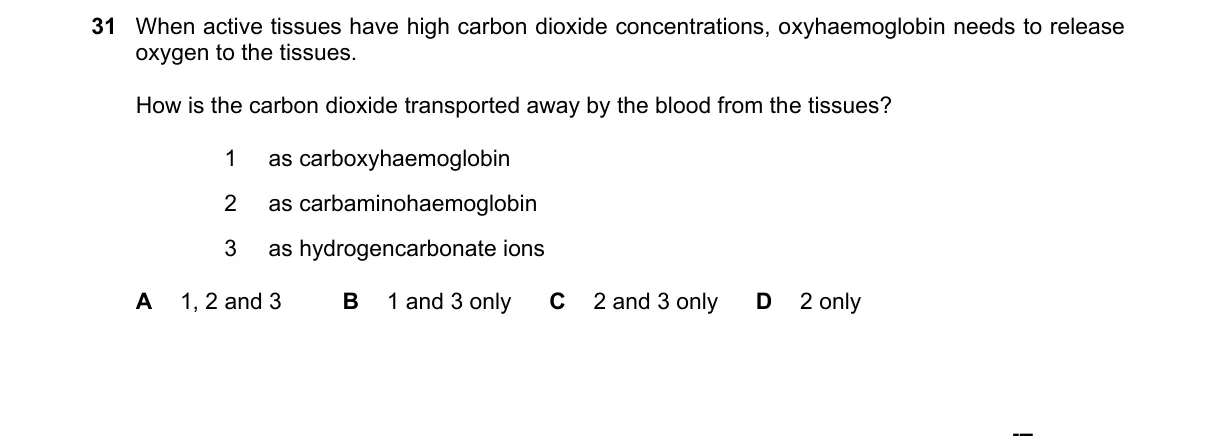
Answer choices
- A1, 2 and 3
- B1 and 3
- C2 and 3 only
- D2 only
Explanation
CO2 Transport Mechanisms in Blood
Steps:
- Identify main CO2 transport forms: dissolved in plasma (1), as bicarbonate ions (3), and bound to hemoglobin as carbaminohemoglobin (2).
- In tissues with high CO2, most CO2 enters RBCs and converts to bicarbonate via carbonic anhydrase for transport (3).
- Some CO2 binds directly to hemoglobin, forming carbaminohemoglobin, aiding removal (2).
- Dissolved CO2 (1) is minimal (~7%) and not primary for efficient transport from active tissues.
Why C is correct:
- Bicarbonate (3) and carbaminohemoglobin (2) account for ~93% of CO2 transport, essential for removing high CO2 from tissues per standard physiology.
Why the others are wrong:
- A includes dissolved CO2 (1), which is insignificant for bulk transport.
- B includes dissolved CO2 (1) but omits carbaminohemoglobin (2), missing a key method.
- D omits bicarbonate (3), the dominant transport form (~70%).
Final answer: C
Topic: Transport of oxygen and carbon dioxide
Practice more A Levels Biology (9700) questions on mMCQ.me