A Levels Biology (9700)•9700/13/O/N/21
A Levels Biology (9700) — 9700/13/O/N/21, Question 27
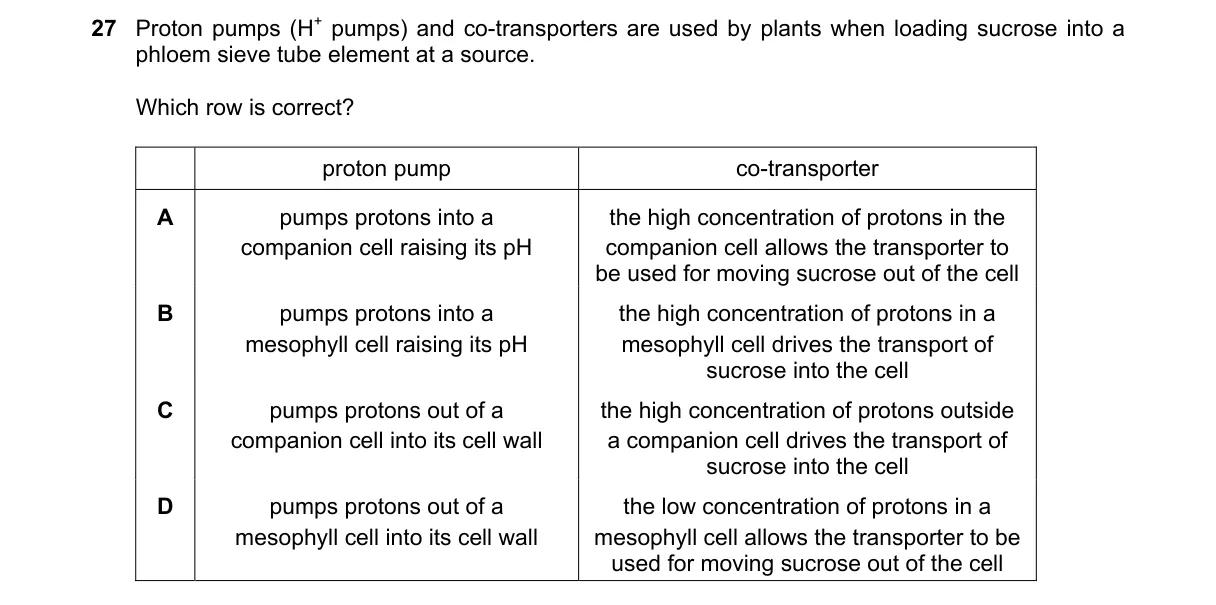
Proton pumps (H+) and co-transporters are used by plants when loading sucrose into a phloem sieve tube element. Which row is correct?
Answer choices
- Aproton pumps into a companion cell raising its pH; the co-transporter in the companion cell is used for moving sucrose out of the cell
- Bmesophyll cells raising its pH; the high concentration of sucrose into the cell driven by transport
- Cpumps protons out of a companion cell into its wall; a high concentration driven by transport
- Dpumps protons out of a mesophyll cell into its wall; the low sucrose into the cell mesophyll cell is used for moving sucrose out of the cell
Explanation
Phloem Sucrose Loading via Proton Gradient
Steps:
- Proton pumps actively export H+ from companion cells into the apoplast, creating an electrochemical gradient.
- This gradient powers sucrose-H+ co-transporters to import sucrose from the apoplast into companion cells against its concentration gradient.
- Sucrose then diffuses into adjacent sieve tube elements for phloem transport.
- Mesophyll cells produce sucrose but do not directly load it into phloem.
Why C is correct:
- It accurately describes proton export from companion cells to establish a proton motive force, driving active sucrose uptake via co-transport per chemiosmotic principles.
Why the others are wrong:
- A: Proton pumps export H+, not import to raise pH; co-transporters import sucrose, not export it.
- B: Mesophyll cells do not load sucrose or raise pH; they supply sucrose to apoplast.
- D: Loading occurs in companion cells, not mesophyll; co-transporters move high apoplast sucrose into cells, not low sucrose out.
Final answer: C
Topic: Transport mechanisms
Practice more A Levels Biology (9700) questions on mMCQ.me