A Levels Biology (9700)•9700/13/O/N/21
A Levels Biology (9700) — 9700/13/O/N/21, Question 15
Cells in the roots of beetroot plants contain red pigment. When pieces of the root are placed into water, some of the red pigment leaks out of the cells into the water. An experiment was carried out to investigate the effect of temperature on the loss of red pigment from the cells. It was found that the higher the temperature of the water, the higher the loss of red pigment from the cells. Which statements could explain this? 1. Enzymes be used for the reactions inside the cells and diffuses out, the pigment can no. 2. As temperature increases, the tertiary structure of protein molecules increases the cell. 3. Fluidity of the phospholipid bilayer and allows the pigment molecules to diffuse out more easily of the phospholipid kinase and allows the pigment molecules to diffuse out.
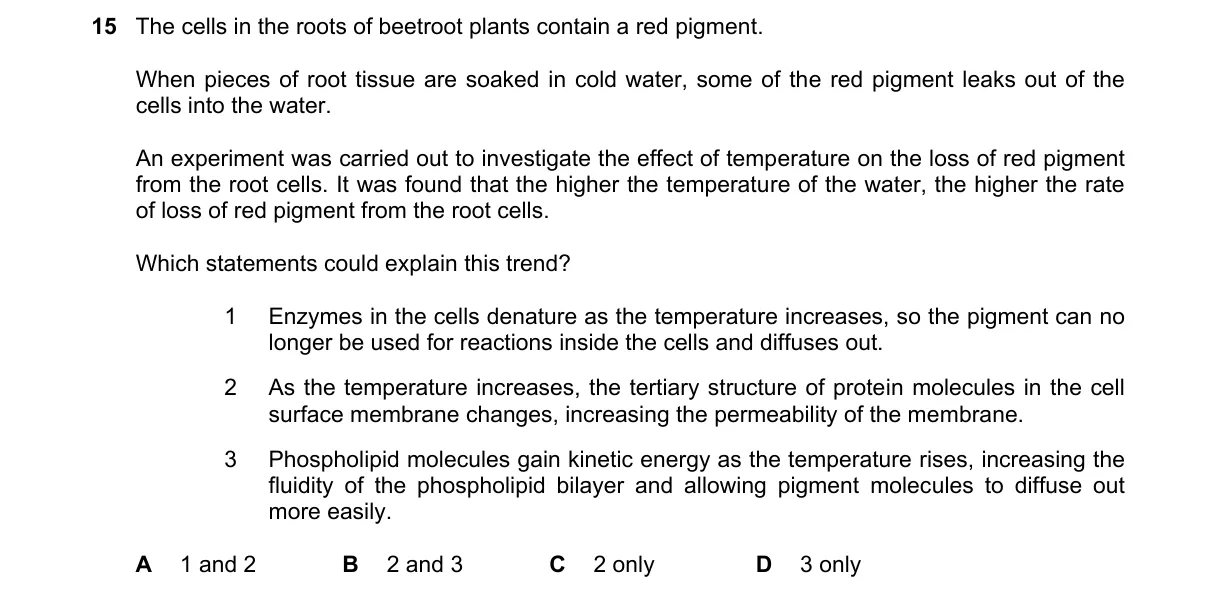
Answer choices
- A1 and 2
- B2 and 3
- C2 only
- D3 only
Explanation
Temperature increases membrane permeability to pigment
Steps:
- Identify that pigment leakage occurs through the cell membrane, a phospholipid bilayer with embedded proteins.
- Recall that higher temperatures increase kinetic energy, affecting membrane components.
- Evaluate statement 1: It is incomplete and mentions enzymes diffusing pigment, which is incorrect as enzymes catalyze reactions, not transport pigment.
- Evaluate statements 2 and 3: Higher temperature denatures membrane proteins (disrupting tertiary structure) and increases bilayer fluidity, both allowing easier pigment diffusion.
Why B is correct:
- Statements 2 and 3 align with the fluid mosaic model, where heat disrupts protein structure and enhances phospholipid movement, increasing permeability per Fick's law of diffusion.
Why the others are wrong:
- A includes invalid statement 1 about enzymes.
- C omits valid statement 3 on bilayer fluidity.
- D omits valid statement 2 on protein structure.
Final answer: B
Topic: Fluid mosaic membranes
Practice more A Levels Biology (9700) questions on mMCQ.me