A Levels Biology (9700)•9700/12/O/N/21
A Levels Biology (9700) — 9700/12/O/N/21, Question 6
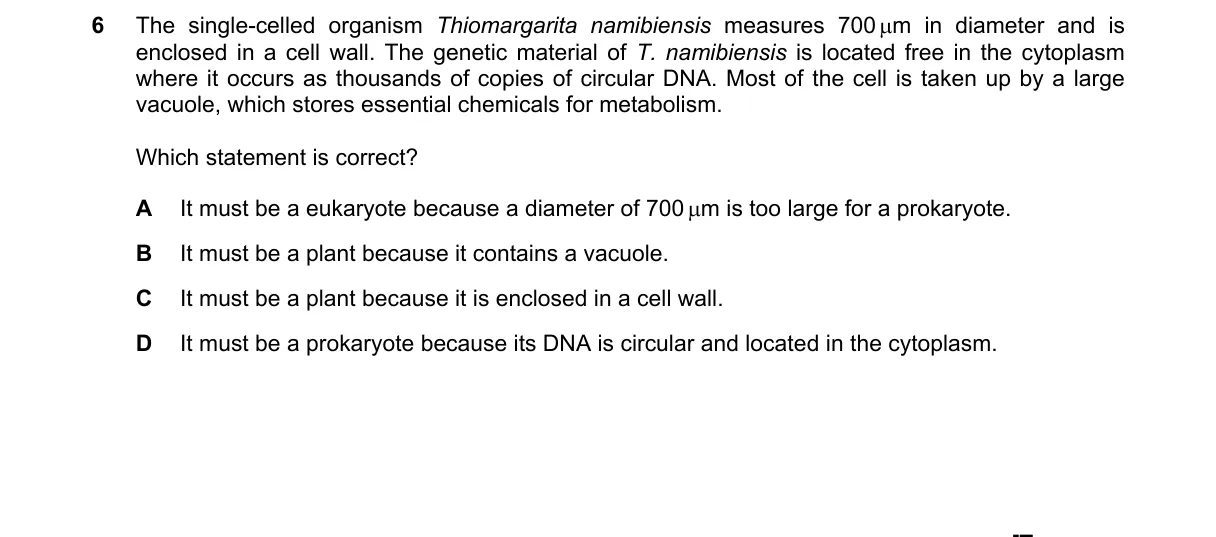
The single-celled organism Thiomargarita namibiensis measures 750 μm in diameter and is enclosed in a cell wall. The genetic material of T. namibiensis is located free in the cytoplasm. Which statement is correct?
Answer choices
- AIt must be a eukaryote because a vacuole of 750 μm is too large for a prokaryote.
- BIt must be a plant because it enclosed in a cell wall.
- CIt must be a prokaryote because its DNA is enclosed in a cell wall.
- DIt must be a prokaryote because its DNA is circular and located in the cytoplasm.
Explanation
Prokaryote Classification by DNA Location
Steps:
- Identify key prokaryotic trait: DNA free in cytoplasm without nuclear membrane.
- Note organism's genetic material is free in cytoplasm, matching prokaryote definition.
- Rule out eukaryote features: no mention of nucleus or organelles.
- Confirm via cell wall and size: compatible with prokaryotes like bacteria.
Why D is correct:
- Prokaryotes have circular DNA in the nucleoid region of the cytoplasm, as defined by the absence of a membrane-bound nucleus.
Why the others are wrong:
- A: Prokaryotes can exceed 750 μm, like T. namibiensis; size alone doesn't classify.
- B: Cell walls occur in both plants (eukaryotes) and bacteria (prokaryotes).
- C: DNA is in cytoplasm, not enclosed by cell wall, which surrounds the entire cell.
Final answer: D
Topic: Cells as the basic units of living organisms
Practice more A Levels Biology (9700) questions on mMCQ.me