A Levels Biology (9700)•9700/12/O/N/21
A Levels Biology (9700) — 9700/12/O/N/21, Question 18
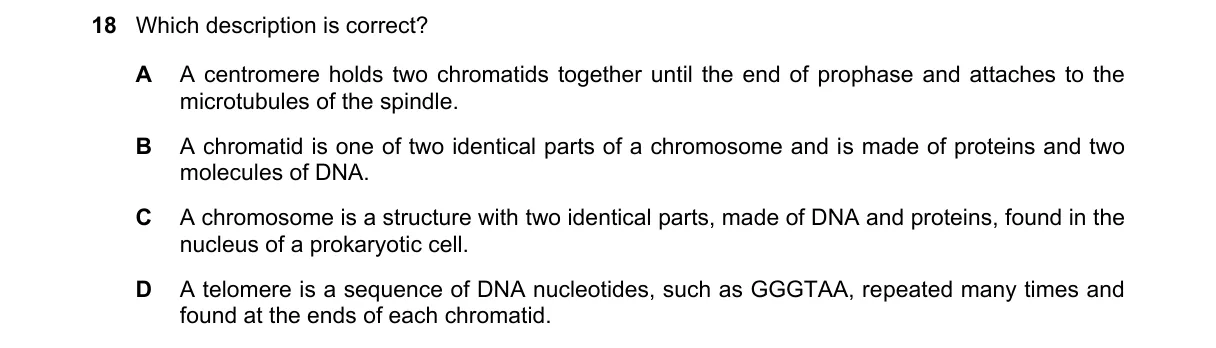
Which description is?
Answer choices
- AA centromere holds two chromatids together until the end of prophase and attaches to the microtubules of the spindle.
- BA chromatid is one of two identical parts of a chromosome and is made of proteins and DNA.
- CA nucleolus is a structure of a prokaryotic cell with two identical parts, made of DNA and proteins, found in the
- DA telomere is a sequence of DNA nucleotides, such as GGTA, repeated many times and found at the ends of each chromatid, such as GGTA repeated many times
Explanation
Identifying Accurate Cellular Structure Descriptions
Steps:
- Recall standard definitions: centromere links sister chromatids until anaphase and binds spindle fibers in prometaphase; chromatid is a replicated chromosome arm of DNA and proteins; nucleolus is an eukaryotic rRNA site, absent in prokaryotes; telomere is protective repetitive DNA at chromosome ends.
- Assess A: centromere timing and attachment are incorrect.
- Assess B: chromatid definition holds but phrasing implies only two parts total, overlooking full chromosome context.
- Assess C: nucleolus is eukaryotic, not prokaryotic.
- Confirm D: matches telomere as repetitive end-sequence on chromatids.
Why D is correct:
- Telomeres are defined as short, repetitive DNA sequences (e.g., TTAGGG in humans or GGGTTA variants) at linear chromosome ends to prevent degradation.
Why the others are wrong:
- A: Centromere holds chromatids until anaphase, not prophase; spindle attachment occurs in prometaphase.
- B: Chromatids form post-replication; description inaccurately simplifies chromosome as only two parts.
- C: Nucleolus exists only in eukaryotic nuclei for ribosome assembly; prokaryotes lack it.
Final answer: D
Topic: Chromosome behaviour in mitosis
Practice more A Levels Biology (9700) questions on mMCQ.me