A Levels Biology (9700) — 9700/12/O/N/21, Question 17
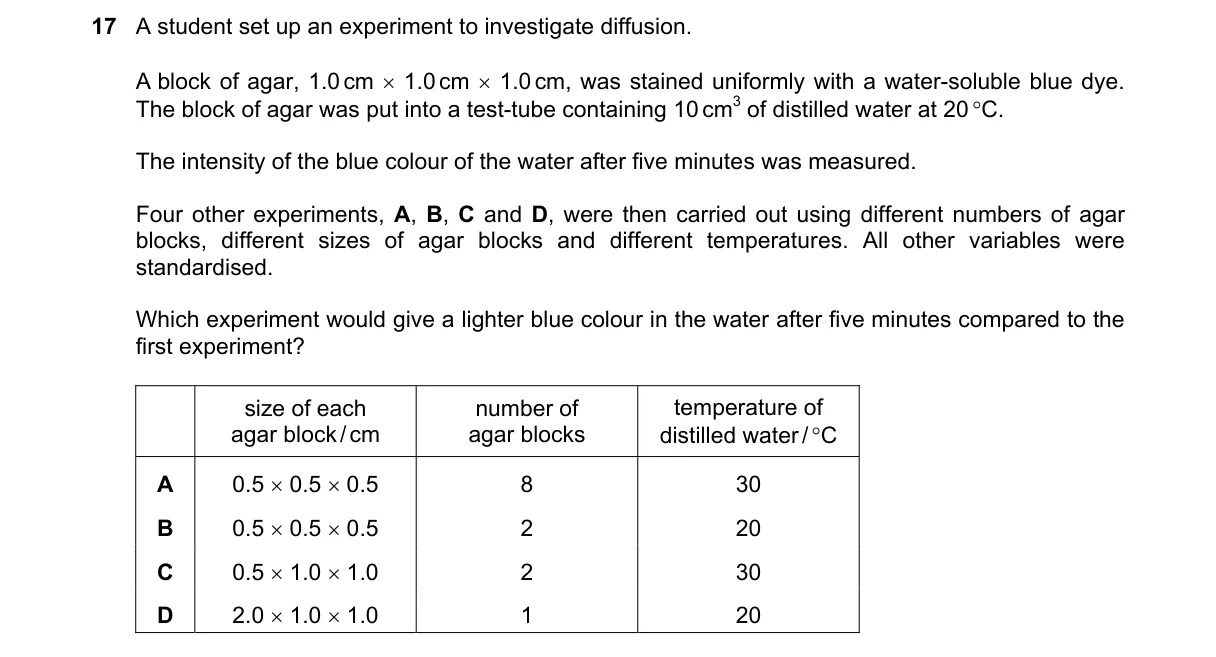
Answer choices
- Asize of each 0.5 × 0.5 cm, number of blocks 8, temperature of distilled water 30°C
- Bsize of each 0.5 × 0.5 cm, number of blocks 2, temperature 20°C
- Csize of each 2.0 × 1.0 cm, number of blocks 1, temperature 30°C
- Dsize of each 2.0 × 1.0 cm, number of blocks 1, temperature 20°C
Explanation
Diffusion rate depends on total surface area and temperature Steps: - Assume first experiment uses 8 blocks of 0.5 × 0.5 cm at 20°C, providing baseline surface area and diffusion rate. - Smaller blocks increase surface area per volume; more blocks increase total surface area; higher temperature accelerates diffusion via increased kinetic energy. - Compare options: calculate qualitative total surface area (small blocks ~1.5 cm² each, large ~7 cm² assuming 2 × 1 × 0.5 cm prism) and adjust for temperature effect. - Lighter color indicates less solute diffusion; select option with lowest total surface area and/or lowest temperature relative to baseline. Why B is correct: - Fewer blocks (2 vs. 8) reduce total surface area to ~25% of baseline at same 20°C, slowing diffusion per Fick's first law (rate ∝ surface area). Why the others are wrong: - A: Same surface area as baseline but 30°C increases diffusion rate ~2x, yielding darker color. - C: Single large block has ~58% baseline surface area but 30°C boosts rate, comparable or darker color. - D: Single large block at 20°C has …
Practice more A Levels Biology (9700) questions on mMCQ.me