A Levels Biology (9700)•9700/12/O/N/21
A Levels Biology (9700) — 9700/12/O/N/21, Question 16
Liver cells contain vesicles that have proteins in their membranes which are specific for the transport of glucose. When these cells need to take up glucose, the vesicles fuse with the cell surface membrane. How does the uptake of glucose occur?
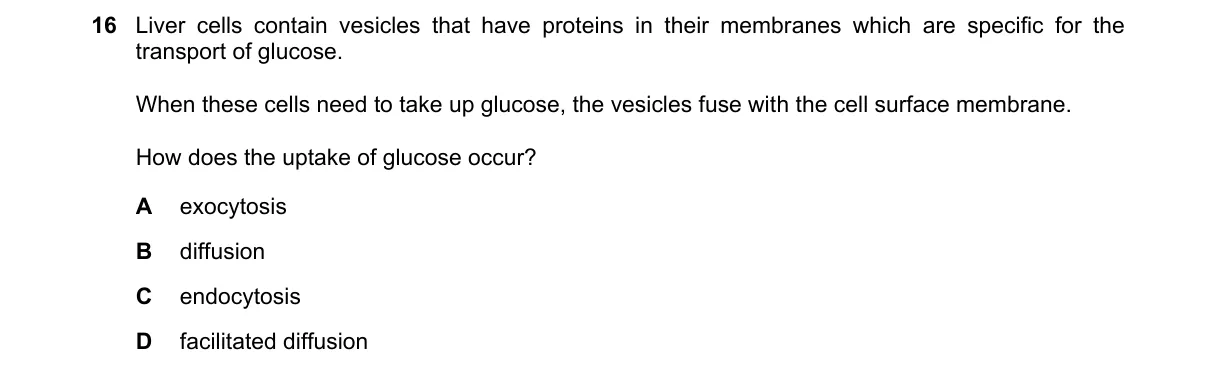
Answer choices
- Aexocytosis
- Bendocytosis
- Cendocytosis
- Dfacilitated diffusion
Explanation
Vesicle fusion inserts glucose transporters for uptake
Steps:
- Vesicles in liver cells carry specific glucose transport proteins in their membranes.
- Upon glucose need, vesicles fuse with the plasma membrane via exocytosis.
- This embeds transport proteins into the cell surface membrane.
- Glucose enters the cell through these proteins via facilitated diffusion.
Why D is correct:
- Facilitated diffusion uses carrier proteins to transport glucose down its concentration gradient, matching the role of inserted membrane proteins.
Why the others are wrong:
- A: Exocytosis releases vesicle contents outside the cell, not enabling internal uptake.
- B: Endocytosis engulfs external materials into vesicles for cell entry, unrelated to fusion for transport insertion.
- C: Endocytosis engulfs external materials into vesicles for cell entry, unrelated to fusion for transport insertion.
Final answer: D
Topic: Movement into and out of cells
Practice more A Levels Biology (9700) questions on mMCQ.me