A Levels Biology (9700)•9700/12/O/N/21
A Levels Biology (9700) — 9700/12/O/N/21, Question 15
The graph shows the relationship between the concentration of substrate and the rate of an enzyme-catalysed reaction. Which row shows how Km and Vmax for this substrate would be affected if the same reaction was carried out in the presence of a competitive inhibitor?
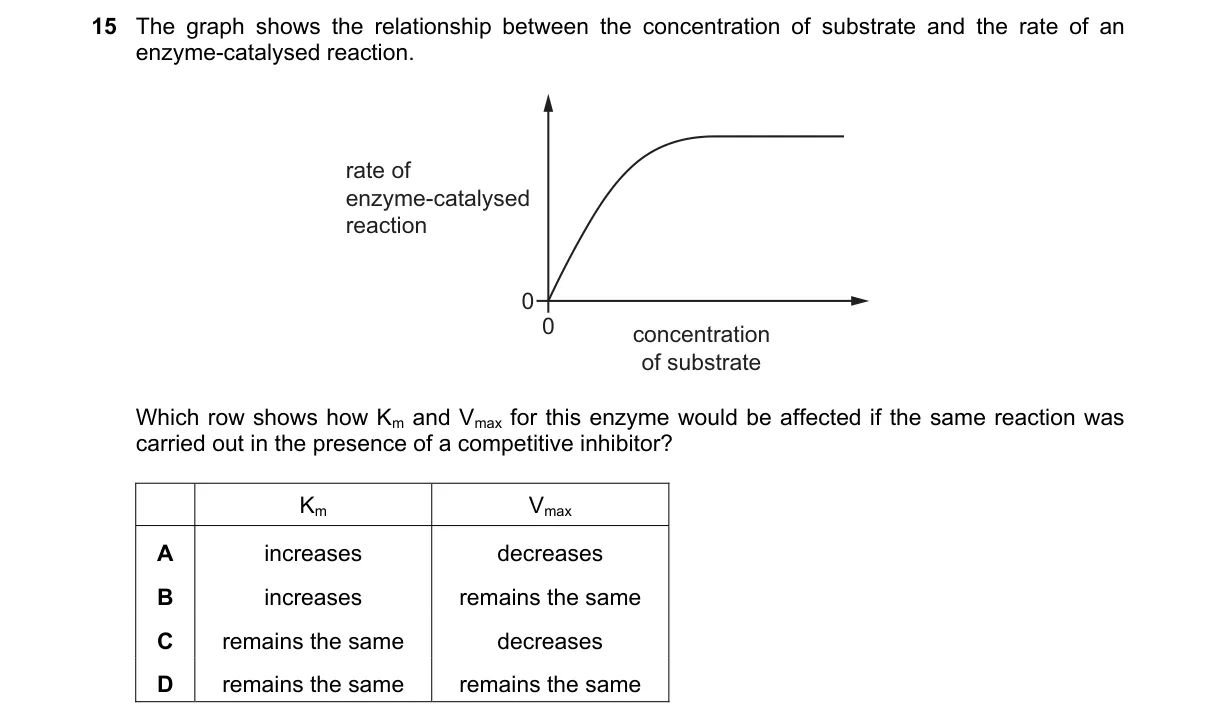
Answer choices
- AKm increases, Vmax decreases
- BKm increases, Vmax remains the same
- CKm remains the same, Vmax decreases
- DKm remains the same, Vmax remains the same
Explanation
Competitive Inhibition in Enzyme Kinetics
Steps:
- Competitive inhibitors bind to the enzyme's active site, competing with substrate and reducing effective enzyme availability.
- This increases the apparent Km, as more substrate is needed to achieve half of Vmax.
- Vmax remains unchanged, since high substrate concentrations displace the inhibitor and saturate the enzyme.
- Thus, the correct description is Km increases, Vmax unchanged.
Why B is correct:
- By definition, competitive inhibition raises apparent Km in the Michaelis-Menten equation (V = Vmax [S] / (Km + [S])), but Vmax stays the same as excess substrate overcomes inhibition.
Why the others are wrong:
- A: Vmax does not decrease; it is unaffected by competitive inhibitors.
- C: Km increases, not remains the same.
- D: Km increases, so it does not remain the same.
Final answer: B
Topic: Factors that affect enzyme action
Practice more A Levels Biology (9700) questions on mMCQ.me