A Levels Biology (9700)•9700/11/O/N/21
A Levels Biology (9700) — 9700/11/O/N/21, Question 32
The graph shows the oxygen dissociation curves for haemoglobin in animals that live at low altitude and animals that live at high altitude. What explains the oxygen dissociation partial pressure at high altitude?
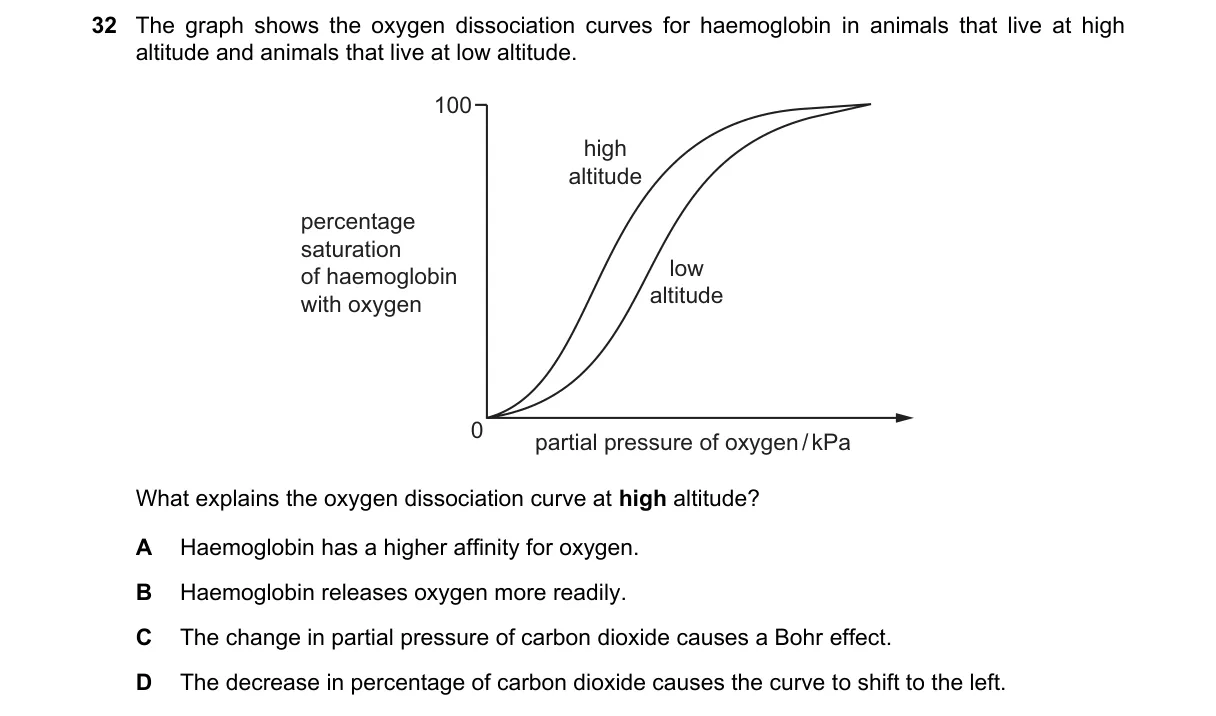
Answer choices
- AHaemoglobin has a higher affinity for oxygen.
- BHaemoglobin releases oxygen more readily.
- CThe change in partial pressure of carbon dioxide causes a Bohr effect.
- DThe decrease in percentage of carbon dioxide causes the curve to shift to the left.
Explanation
High-Altitude Adaptation via Increased Hemoglobin-Oxygen Affinity
Steps:
- At high altitudes, atmospheric pO2 is lower, reducing oxygen availability.
- Animals adapt by evolving hemoglobin with higher oxygen affinity to load O2 effectively at low pO2.
- This shifts the dissociation curve leftward, lowering the partial pressure for 50% saturation (P50).
- The left shift ensures sufficient arterial oxygenation despite hypoxia.
Why A is correct:
- Higher affinity lowers P50 on the oxygen-hemoglobin dissociation curve, enabling saturation at reduced pO2 as defined by the curve's sigmoidal shape and cooperative binding.
Why the others are wrong:
- B: Readily releasing oxygen indicates lower affinity and a right-shifted curve, worsening loading at low pO2.
- C: Bohr effect involves pH/CO2-induced shifts, but the curve difference here is due to inherent hemoglobin structure, not acute gas changes.
- D: CO2 decrease via Bohr effect could shift left, but high-altitude adaptation is genetic, not environmental CO2 variation.
Final answer: A
Topic: Transport of oxygen and carbon dioxide
Practice more A Levels Biology (9700) questions on mMCQ.me