A Levels Biology (9700)•9700/11/O/N/21
A Levels Biology (9700) — 9700/11/O/N/21, Question 28
The parts of the heart that control heart action are listed.
• sinoatrial node (SAN)
• atrioventricular node (AVN)
• Purkyne tissue
Which row correctly describes atrial contraction and ventricular contraction?
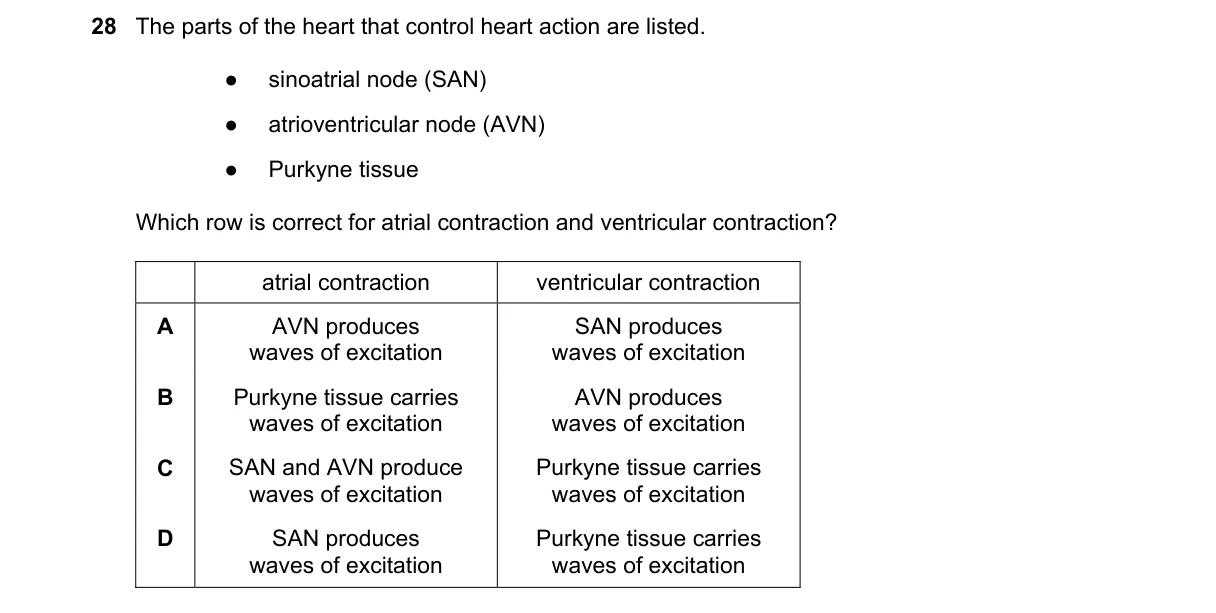
Answer choices
- AAtrial contraction: AVN produces waves of excitation; Ventricular contraction: SAN produces waves of excitation
- BAtrial contraction: Purkyne tissue carries waves of excitation; Ventricular contraction: AVN produces waves of excitation
- CAtrial contraction: SAN produces waves of excitation; Ventricular contraction: Purkyne tissue carries waves of excitation
- DAtrial contraction: waves of excitation; Ventricular contraction: waves of excitation
Explanation
Heart conduction system triggers contractions via electrical waves
Steps:
- SAN acts as pacemaker, generating initial electrical impulse that spreads through atria, causing atrial contraction.
- Impulse reaches AVN, which delays it slightly before passing to bundle of His.
- Purkyne fibers rapidly conduct impulse through ventricular walls, synchronizing ventricular contraction.
- Both atria and ventricles contract due to propagated waves of excitation, not isolated node actions.
Why D is correct:
- Both atrial and ventricular contractions are triggered by waves of excitation through the conduction system, as defined by cardiac electrophysiology where impulses propagate to coordinate heartbeats.
Why the others are wrong:
- A: Reverses roles; SAN initiates atrial, not ventricular, excitation.
- B: Purkyne tissue conducts in ventricles, not atria; AVN delays, doesn't produce ventricular waves.
- C: SAN correctly starts atrial waves, but Purkyne carries ventricular, not produces, excitation.
Final answer: D
Topic: The heart
Practice more A Levels Biology (9700) questions on mMCQ.me