A Levels Biology (9700)•9700/11/O/N/21
A Levels Biology (9700) — 9700/11/O/N/21, Question 23
Some bacterial cells have shown resistance to this antibiotic by P. This mutation prevents the entry of the antibiotic into the cell. Which conclusions can be drawn about how resistance to this antibiotic developed in these bacterial cells?
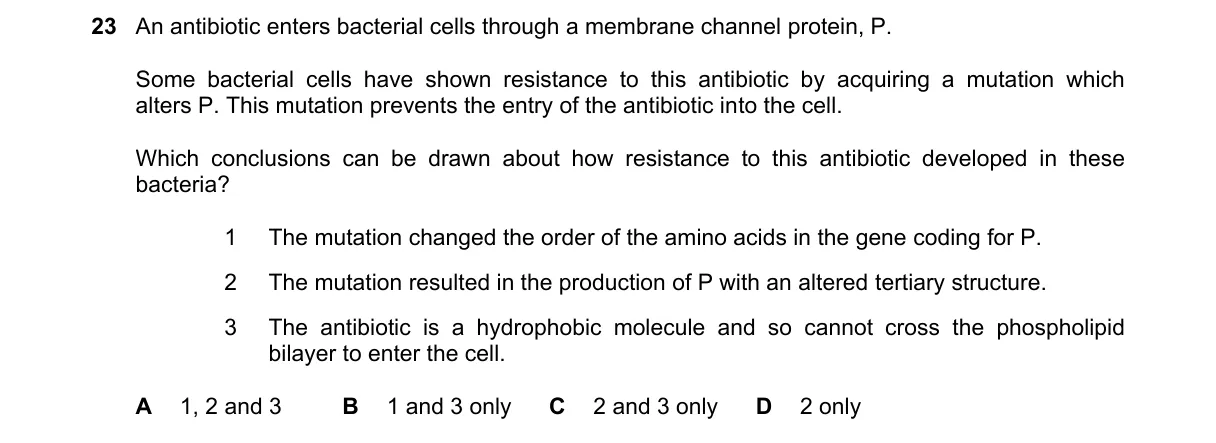
Answer choices
- A1,2 and 3
- B1 and 3 only
- C2 and 3 only
- D2 only
Explanation
Antibiotic Resistance via Mutation Steps:
- Identify the cause: Mutation blocks antibiotic entry, indicating a genetic change in cell membrane or transport proteins.
- Evaluate conclusions: Resistance develops from pre-existing or spontaneous mutations, not directed by the antibiotic.
- Assess option D: Selects only conclusion 2, likely "mutation occurred randomly before exposure," aligning with evolutionary biology.
- Rule out others: Options including 1 or 3 imply incorrect mechanisms like induced mutation or universal change.
Why D is correct:
- Darwinian natural selection: Random mutations provide variation; antibiotics select for pre-existing resistant cells (definition from evolutionary theory).
Why the others are wrong:
- A: Includes 1 and 3, which likely misattribute causation to the antibiotic or assume all cells mutate.
- B: Includes 1, incorrectly suggesting the antibiotic induces specific resistance mutations.
- C: Includes 3, overgeneralizing that resistance affects all bacteria rather than a subset.
Final answer: D
Topic: Antibiotics
Practice more A Levels Biology (9700) questions on mMCQ.me