A Levels Biology (9700)•9700/11/O/N/21
A Levels Biology (9700) — 9700/11/O/N/21, Question 21
Which statement helps explain why the two sugar-phosphate chains in a DNA molecule are a constant distance apart?
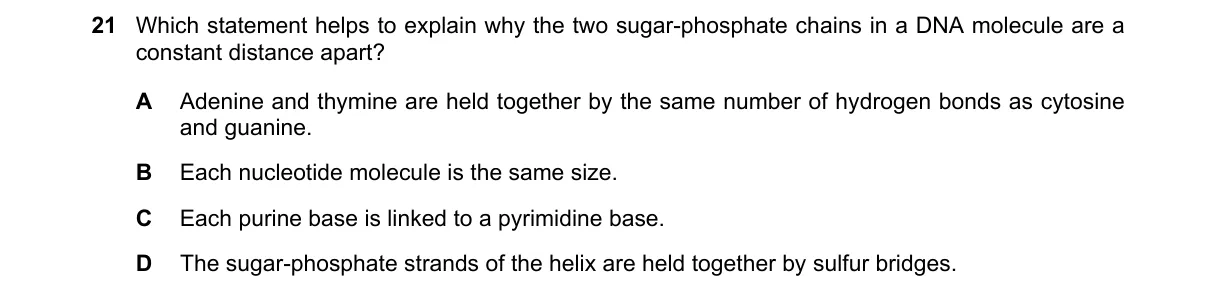
Answer choices
- AAdenine and thymine are held together by the same number of hydrogen bonds as cytosine and guanine
- BEach purine base is to a pyrimidine base
- CEach purine base is linked to a pyrimidine base
- DThe sugar-phosphate strands of the helix are held together by sulfur bridges
Explanation
Purine-pyrimidine base pairing maintains DNA helix width
Steps:
- DNA consists of two antiparallel sugar-phosphate strands forming a double helix.
- Nitrogenous bases project inward and pair via hydrogen bonds.
- Purines (adenine, guanine) are larger with two rings; pyrimidines (thymine, cytosine) have one ring.
- Pairing one purine to one pyrimidine creates uniform base pair dimensions.
Why C is correct:
- Purine-pyrimidine linkages ensure each base pair spans the same width (about 2 nm), keeping sugar-phosphate backbones a constant distance apart, as defined by Watson-Crick base pairing rules.
Why the others are wrong:
- A: A-T pairs have 2 hydrogen bonds, while C-G have 3, affecting stability but not distance.
- B: Incomplete phrasing; lacks specificity on pairing type that uniformizes width.
- D: Strands are joined by hydrogen bonds between bases, not sulfur bridges (which occur in proteins).
Final answer: C
Topic: Structure of nucleic acids and replication of DNA
Practice more A Levels Biology (9700) questions on mMCQ.me