A Levels Biology (9700)•9700/13/O/N/20
A Levels Biology (9700) — 9700/13/O/N/20, Question 36
The diagrams show the result of incubating two species of bacteria, P and R, on separate Petri dishes. Filter paper discs have been added to each Petri dish. key N = no antibiotic X = antibiotic X Y = antibiotic Y Which statement is correct?
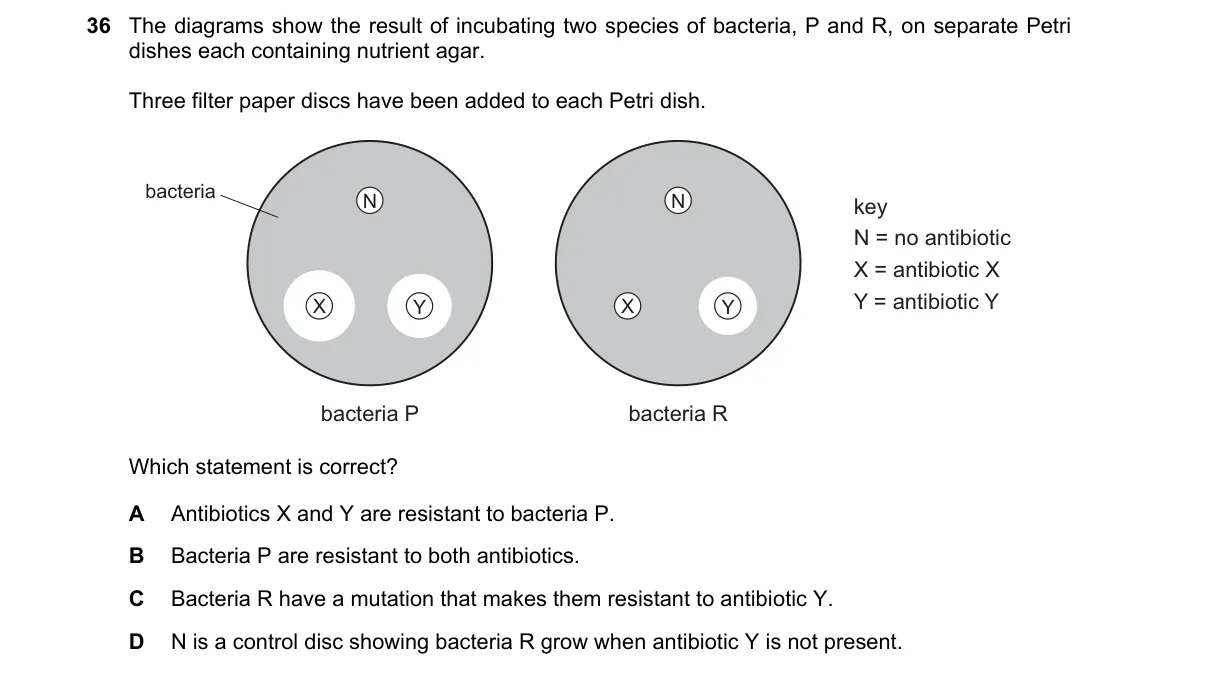
Answer choices
- ABacteria P and R are resistant to both antibiotics.
- BBacteria P have a mutation that makes them resistant to antibiotic Y.
- CN is a control dish showing R grown when antibiotic Y is not present.
- DBacteria R have a mutation that makes them resistant to both antibiotics.
Explanation
Interpreting Bacterial Resistance via Inhibition Zones
Steps:
- Identify N as the control with no antibiotic, showing unrestricted bacterial growth for comparison.
- For bacteria P, observe a clear zone around antibiotic X disc (indicating sensitivity) but no zone around Y (indicating resistance to Y).
- For bacteria R, observe no clear zones around either X or Y discs, indicating resistance to both antibiotics.
- Conclude resistance in R likely results from a genetic mutation allowing growth despite antibiotics.
Why D is correct:
- In antibiotic sensitivity tests, lack of inhibition zones around both X and Y discs for R demonstrates resistance to both, typically due to a mutation conferring this trait.
Why the others are wrong:
- A: P shows sensitivity to X (clear zone), so not resistant to both.
- B: P's resistance is to Y only, not due to a specified mutation; R shows broader resistance.
- C: N is a general control without any antibiotic, not specific to Y's absence for R.
Final answer: D
Topic: Antibiotics
Practice more A Levels Biology (9700) questions on mMCQ.me