A Levels Biology (9700)•9700/13/O/N/20
A Levels Biology (9700) — 9700/13/O/N/20, Question 16
Solute X is at a higher concentration outside a cell than in the cytoplasm. Which processes may solute X be moved through the cell surface membrane?
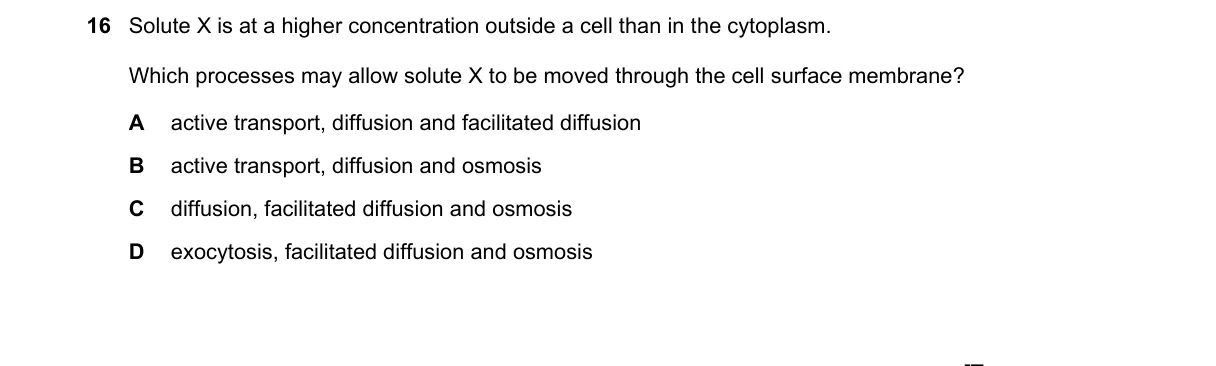
Answer choices
- Aactive transport, diffusion and facilitated diffusion
- Bdiffusion, facilitated diffusion and osmosis
- Cdiffusion, facilitated diffusion and osmosis
- Dexocytosis, facilitated diffusion and osmosis
Explanation
Solute transport across membrane with external concentration gradient
Steps:
- Note higher solute X concentration outside cell creates inward down-gradient for passive entry.
- Identify passive solute transport: simple diffusion (lipid-soluble, no proteins) and facilitated diffusion (channel/carrier proteins).
- Consider active transport: uses energy to move solutes against gradient, enabling outward movement here.
- Exclude non-solute processes: osmosis (water only) and exocytosis (vesicle bulk export).
Why A is correct:
- Active transport moves solutes against concentration gradient via ATP hydrolysis (e.g., sodium-potassium pump), while diffusion and facilitated diffusion follow gradient per Fick's law.
Why the others are wrong:
- B and C include osmosis, which drives water movement via osmosis, not solutes.
- D includes exocytosis, a bulk secretory process unrelated to individual solute diffusion.
Final answer: A
Topic: Movement into and out of cells
Practice more A Levels Biology (9700) questions on mMCQ.me