A Levels Biology (9700)•9700/12/O/N/20
A Levels Biology (9700) — 9700/12/O/N/20, Question 7
Diastase is an enzyme that breaks down starch into maltose. Maltose is a reducing sugar. A sample of starch is treated with boiled diastase and left 15 minutes. Samples of the mixture are then tested with iodine solution and with Benedict's reagent. What are the results?
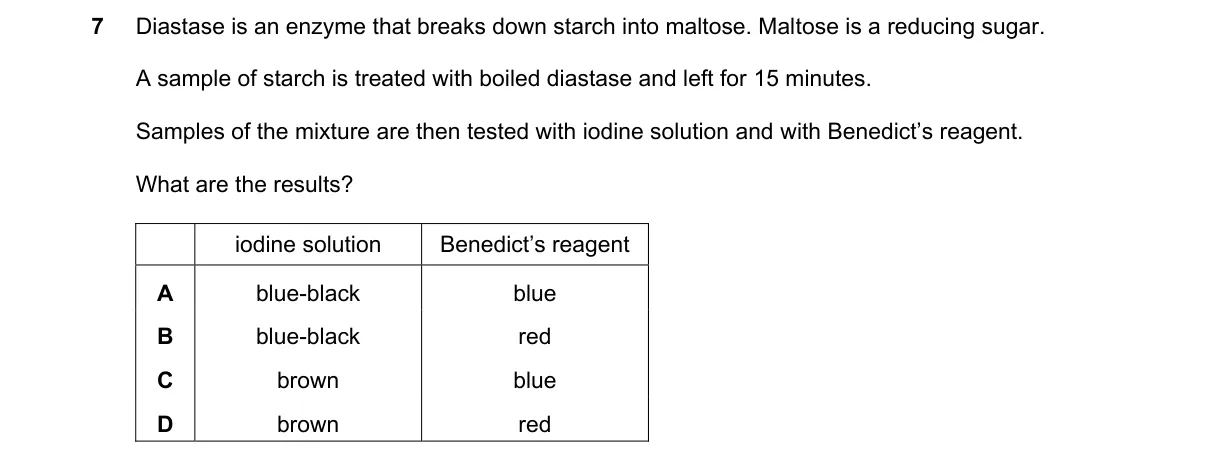
Answer choices
- AIodine solution: blue-black, Benedict's reagent: blue
- BIodine solution: blue-black, Benedict's reagent: red
- CIodine solution: brown, Benedict's reagent: red
- DIodine solution: brown, Benedict's reagent: blue
Explanation
Boiled diastase fails to hydrolyze starch
Steps:
- Boiling denatures diastase, inactivating the enzyme.
- Untreated starch remains intact after 15 minutes.
- Iodine reacts with starch to produce blue-black color.
- Benedict's reagent detects no reducing sugars, staying blue.
Why A is correct:
- Inactivated enzyme leaves starch unchanged, yielding blue-black with iodine (starch test) and blue with Benedict's (no reducing maltose).
Why the others are wrong:
- B: Benedict's red indicates reducing sugar, but no maltose forms.
- C: Iodine brown suggests absent starch, but starch persists.
- D: Iodine brown wrongly implies starch breakdown.
Final answer: A
Topic: Factors that affect enzyme action
Practice more A Levels Biology (9700) questions on mMCQ.me