A Levels Biology (9700)•9700/12/O/N/20
A Levels Biology (9700) — 9700/12/O/N/20, Question 40
A graft, tissue, such as skin, from a different person is usually rejected by the body. Which statement about graft rejection is correct?
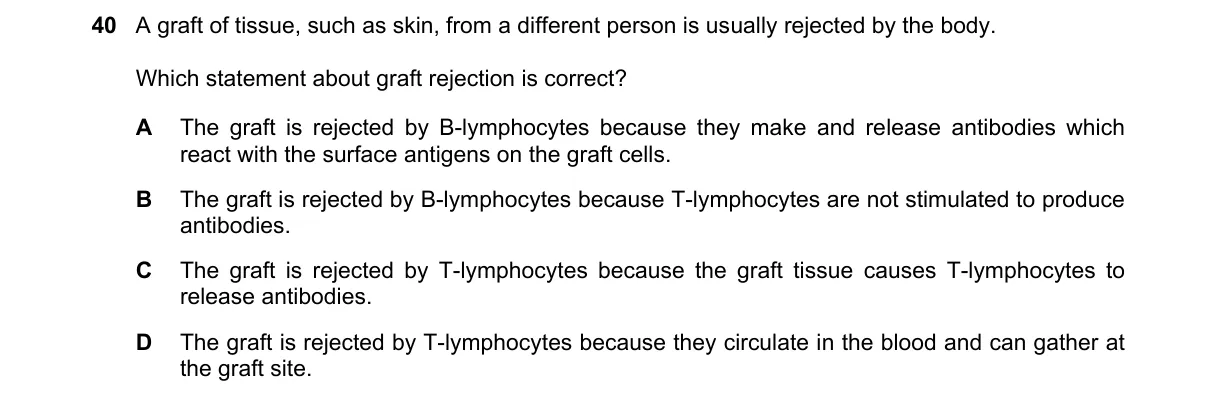
Answer choices
- AThe graft is rejected by B-lymphocytes because they make and release antibodies which react with the graft surface.
- BThe graft is rejected by B-lymphocytes because T-lymphocytes are not stimulated to produce antibodies.
- CThe graft is rejected by T-lymphocytes because the graft tissue causes T-lymphocytes to release antibodies.
- DThe graft is rejected by T-lymphocytes because they circulate in the blood and can gather at the graft site.
Explanation
T-lymphocytes drive cell-mediated graft rejection
Steps:
- Graft rejection occurs when the immune system detects foreign MHC antigens on donor tissue.
- T-lymphocytes recognize these antigens via direct cell-cell contact, unlike B-lymphocytes which rely on antibodies.
- Activated T-cells proliferate and migrate to the graft site to destroy it.
- This process is cell-mediated immunity, not humoral (antibody-based).
Why D is correct:
- T-lymphocytes circulate in blood and infiltrate the graft site to mount a cytotoxic response, as defined in cell-mediated immunity.
Why the others are wrong:
- A: Rejection is primarily T-cell mediated; B-cells and antibodies play a secondary role in some cases.
- B: T-lymphocytes stimulate B-cells but directly reject grafts via cytotoxicity, not antibody production.
- C: T-lymphocytes release cytokines, not antibodies; antibody production is a B-cell function.
Final answer: D
Topic: The immune system
Practice more A Levels Biology (9700) questions on mMCQ.me