A Levels Biology (9700)•9700/12/O/N/20
A Levels Biology (9700) — 9700/12/O/N/20, Question 30
Which set labels correctly?
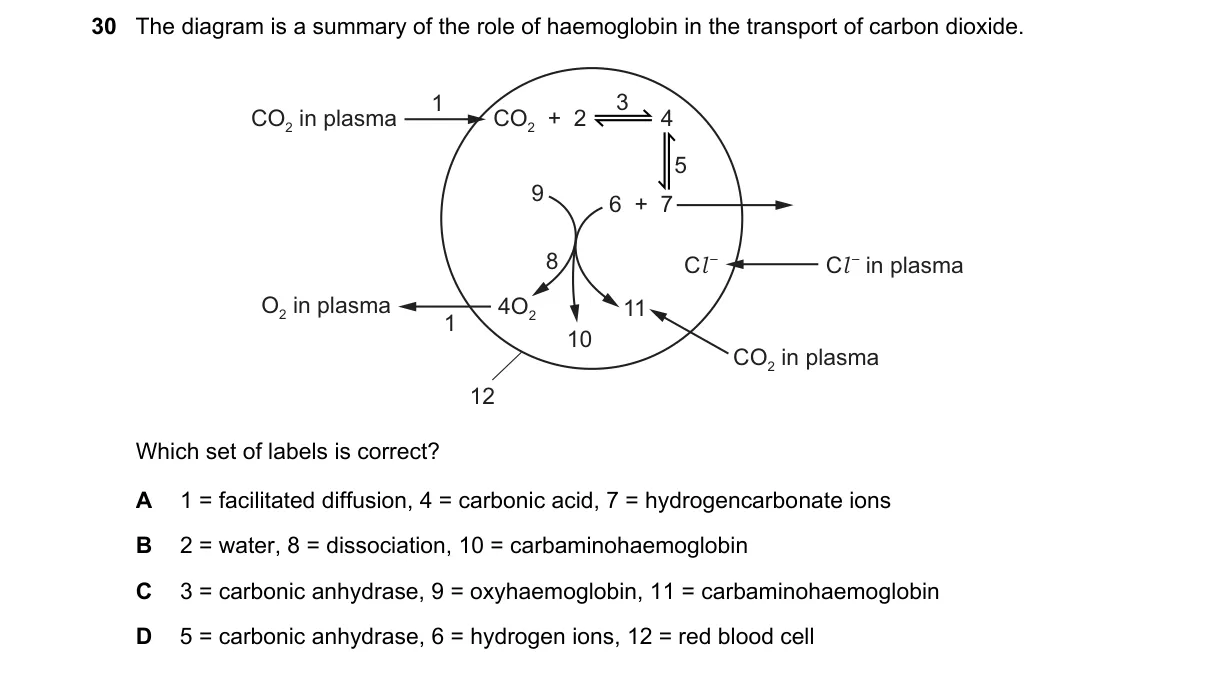
Answer choices
- A1 = water, 8 = facilitated diffusion, 10 = carbaminohaemoglobin ions
- B1 = facilitated diffusion, 4 = carbonic anhydrase, 7 = hydrogencarbonate ions
- C3 = carbonic anhydrase, 9 = oxyhaemoglobin, 11 = carbaminohaemoglobin
- D5 = carbonic anhydrase, 6 = hydrogen ions, 12 = red blood cell
Explanation
Labeling CO2 transport in red blood cells
Steps:
- Recall CO2 enters RBCs and reacts with water via carbonic anhydrase to form carbonic acid.
- Carbonic acid dissociates into H+ and HCO3-, with H+ buffered by haemoglobin.
- Haemoglobin binds O2 as oxyhaemoglobin and CO2 as carbaminohaemoglobin.
- Match labels: enzyme at 3, O2-Hb at 9, CO2-Hb at 11.
Why C is correct:
- Carbonic anhydrase (label 3) catalyzes CO2 hydration per the reaction CO2 + H2O ⇌ H2CO3, essential for bicarbonate formation; oxyhaemoglobin (9) and carbaminohaemoglobin (11) are standard Hb complexes in O2/CO2 transport.
Why the others are wrong:
- A: Carbaminohaemoglobin does not involve ions; it's direct Hb-CO2 binding.
- B: Facilitated diffusion (1) applies to glucose, not CO2 entry; hydrogencarbonate ions (7) form inside RBCs, not labeled there.
- D: Carbonic anhydrase is in RBC cytoplasm (not 5); red blood cell (12) is the whole structure, not a specific component.
Final answer: C
Topic: Transport of oxygen and carbon dioxide
Practice more A Levels Biology (9700) questions on mMCQ.me