A Levels Biology (9700)•9700/12/O/N/20
A Levels Biology (9700) — 9700/12/O/N/20, Question 19
In eukaryotes, the chromosomes become shorter and thicker during mitosis. The thickening may be increased by molecules called protamines. The protamines replace part of the structure of the chromosome. Which part of the chromosome is replaced by protamines?
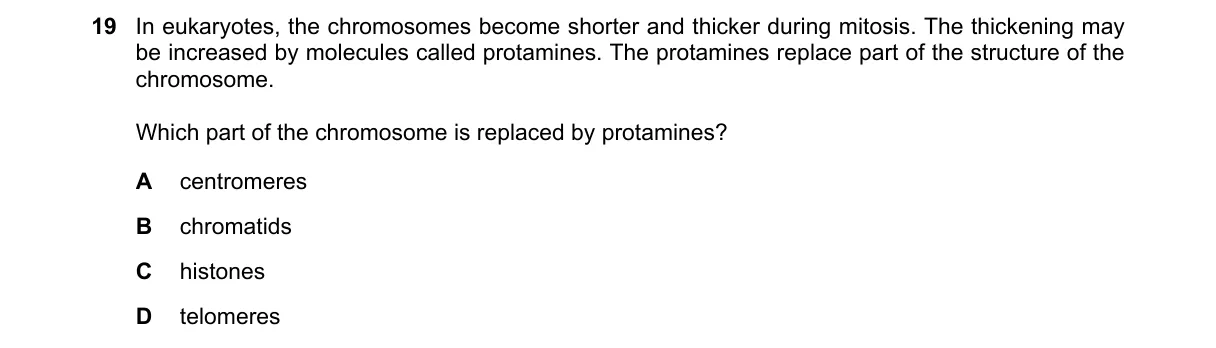
Answer choices
- Acentromeres
- Bchromatids
- Chistones
- Dtelomeres
Explanation
Protamines Replace Histones for Chromosome Condensation
Steps:
- Chromosomes condense during mitosis by coiling DNA around proteins.
- Histones form nucleosomes that package DNA into chromatin.
- Protamines are basic proteins that bind DNA more tightly than histones.
- During mitosis, protamines displace histones to increase chromosome thickness and compactness.
Why C is correct:
- Histones are the core proteins in nucleosomes; protamines replace them to achieve higher-order chromatin folding, as defined in eukaryotic chromosome structure.
Why the others are wrong:
- A. Centromeres are DNA sequences for kinetochore assembly, not protein components replaced by protamines.
- B. Chromatids are duplicated chromosome structures, not molecular parts displaced by proteins.
- D. Telomeres are protective DNA caps at chromosome ends, unaffected by protamine replacement.
Final answer: C
Topic: Chromosome behaviour in mitosis
Practice more A Levels Biology (9700) questions on mMCQ.me