A Levels Biology (9700)•9700/12/O/N/20
A Levels Biology (9700) — 9700/12/O/N/20, Question 16
Four bars are stained green using universal indicator and suspended in 1 mol dm³ hydrochloric acid. The time taken for the agar blocks to change from green to red was recorded. Which agar block would be the first to become completely red?
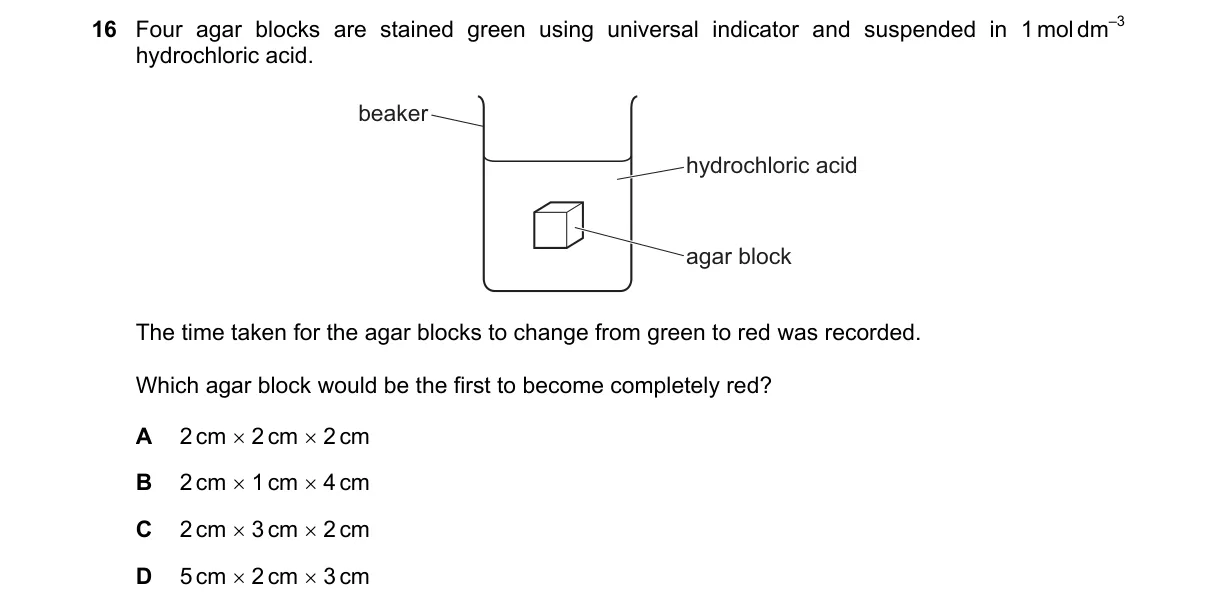
Answer choices
- A2 cm × 2 cm × 2 cm
- B2 cm × 1 cm × 4 cm
- C2 cm × 3 cm × 4 cm
- D5 cm × 2 cm × 3 cm
Explanation
Surface Area to Volume Ratio Determines Diffusion Rate
Steps:
- Calculate volume for each block: multiply length × width × height.
- Calculate total surface area: 2(lw + lh + wh) for rectangular prisms.
- Compute SA/V ratio; higher ratio means faster acid diffusion and color change.
- Compare ratios: highest SA/V turns red first.
Why B is correct:
- B (2×1×4 cm) has SA/V = 3 cm⁻¹, highest due to one thin dimension maximizing surface relative to volume.
Why the others are wrong:
- A (2×2×2 cm): SA/V = 3 cm⁻¹, equal to B but bulkier shape slows uniform diffusion.
- C (2×3×4 cm): SA/V = 1.5 cm⁻¹, lower from larger dimensions reducing relative surface.
- D (5×2×3 cm): SA/V ≈ 1.4 cm⁻¹, lowest from overall larger size minimizing ratio.
Final answer: B
Topic: Movement into and out of cells
Practice more A Levels Biology (9700) questions on mMCQ.me