A Levels Biology (9700)•9700/12/O/N/20
A Levels Biology (9700) — 9700/12/O/N/20, Question 15
Equal-sized potato pieces were placed into test-tubes containing equal volumes of different concentrations of sucrose solution and left for 30 minutes. All other variables were controlled. After 30 minutes, the potato piece in one of the concentrations of sucrose solution had not changed in size. What can be concluded from the result for this potato piece? 1. The concentration of the sucrose solution is the same as the concentration of the potato. 2. The water potential of the potato is the same as the water potential of the sucrose solution. 3. There is no more movement of water into or out of the potato.
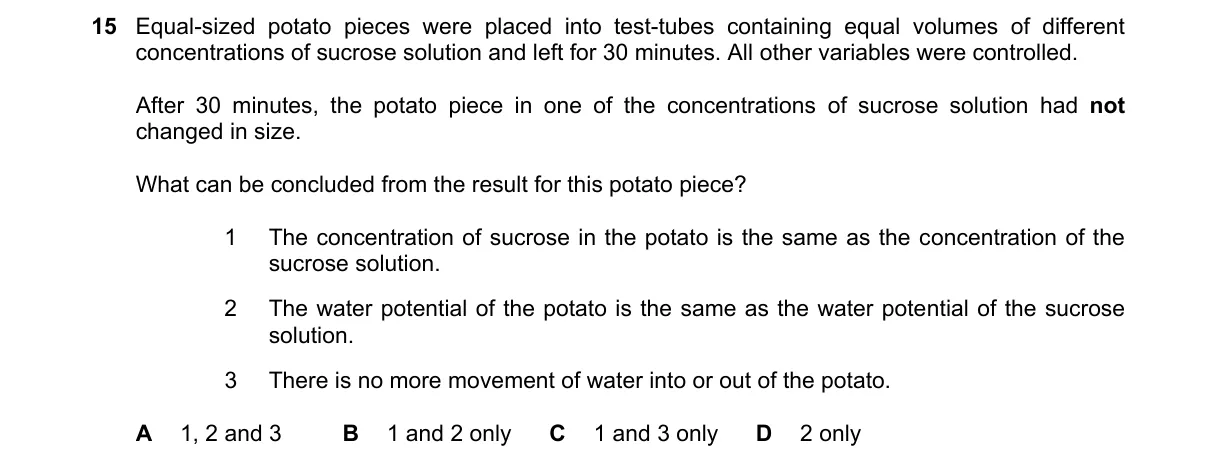
Answer choices
- A1, 2 and 3
- B1 and 2
- C1 and 3 only
- D2 only
Explanation
Osmotic Equilibrium in Potato Cells
Steps:
- Potato size unchanged indicates no net water movement, so osmosis is at equilibrium.
- Equilibrium occurs when water potentials are equal, preventing net flow.
- Sucrose concentration affects solution water potential, but potato's is due to solutes inside cells.
- Thus, equal water potentials mean no size change, regardless of exact concentrations.
Why D is correct:
- Water potential equality defines osmotic equilibrium, where net water movement stops (ψ_potato = ψ_solution).
Why the others are wrong:
- 1: Concentrations may differ; potato water potential includes pressure and solute effects, not just sucrose concentration.
- 3: Water molecules still diffuse both ways, but net movement is zero at equilibrium.
Final answer: D
Topic: Movement into and out of cells
Practice more A Levels Biology (9700) questions on mMCQ.me