A Levels Biology (9700)•9700/12/O/N/20
A Levels Biology (9700) — 9700/12/O/N/20, Question 14
The painkiller ibuprofen reduces the activity of an enzyme involved in the production of prostaglandins by binding reversibly to the active site of the enzyme. Which type of enzyme inhibition describes this example and why?
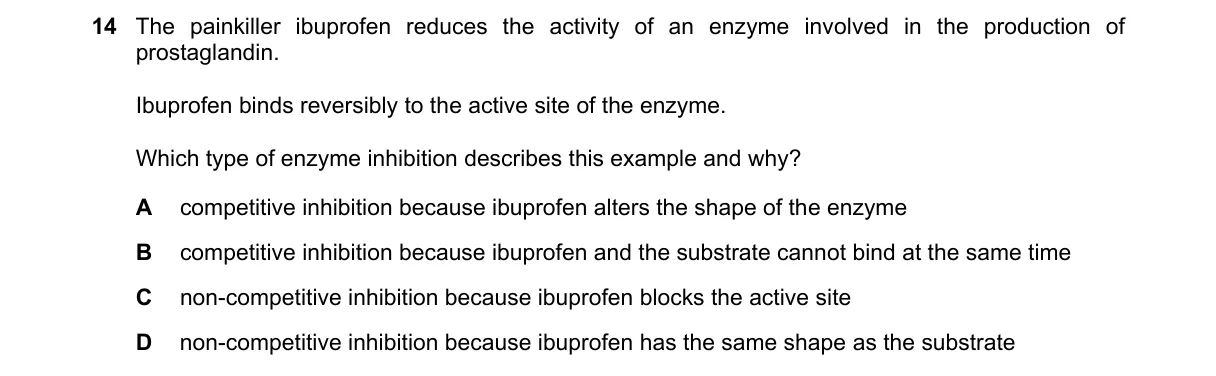
Answer choices
- Acompetitive inhibition because ibuprofen and the substrate cannot bind at the same time
- Bnon-competitive inhibition because ibuprofen alters the shape of the enzyme
- Cnon-competitive inhibition because ibuprofen blocks the active site
- Dnon-competitive inhibition because ibuprofen has the same shape as the substrate
Explanation
Ibuprofen as Competitive Inhibitor
Steps:
- Identify key detail: Ibuprofen binds reversibly to the enzyme's active site, blocking substrate access.
- Recall definitions: Competitive inhibition occurs when inhibitor and substrate vie for the active site; non-competitive binds elsewhere, altering enzyme shape.
- Match to example: Binding to active site means competition with substrate, not shape alteration at another site.
- Eliminate mismatches: Reasons in B, C, D describe non-competitive traits or incorrect mechanisms.
Why A is correct:
- Competitive inhibition definition: Inhibitor binds active site, preventing substrate binding; ibuprofen fits as it reversibly occupies the site, mimicking substrate competition.
Why the others are wrong:
- B: Non-competitive inhibitors bind allosteric sites to alter shape, not the active site.
- C: Blocking active site defines competitive, not non-competitive inhibition.
- D: Substrate shape similarity is a competitive trait, but option wrongly labels it non-competitive.
Final answer: A
Topic: Mode of action of enzymes
Practice more A Levels Biology (9700) questions on mMCQ.me