A Levels Biology (9700)•9700/11/O/N/20
A Levels Biology (9700) — 9700/11/O/N/20, Question 40
Which describes passive immunity?
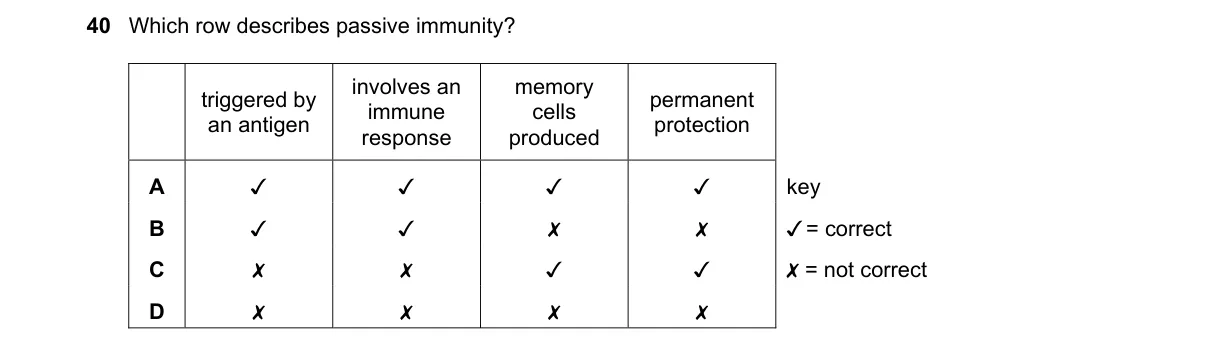
Answer choices
- Atriggered by an antigen: ✓, involves an immune response: ✓, memory cells produced: X, permanent protection: X
- Btriggered by an antigen: ✓, involves an immune response: ✓, memory cells produced: X, permanent protection: X
- Ctriggered by an antigen: X, involves an immune response: X, memory cells produced: X, permanent protection: X
- Dtriggered by an antigen: X, involves an immune response: X, memory cells produced: X, permanent protection: X
Explanation
Passive immunity lacks active immune engagement Steps:
- Recall passive immunity involves receiving pre-formed antibodies (e.g., from mother or injection), not self-generated.
- Identify key traits: no antigen trigger in recipient, no immune response activation, no memory cells formed, protection is temporary.
- Compare to active immunity: antigen-triggered, response involved, memory cells produced, long-term protection.
- Match option with all negatives (X) to passive immunity definition.
Why D is correct:
- Passive immunity transfers ready antibodies, bypassing antigen exposure, immune activation, memory formation, and providing only short-term protection.
Why the others are wrong:
- A describes partial active immunity traits (antigen trigger and response) but incorrectly negates memory and permanence.
- B identical to A, so mismatches passive by including antigen and response elements.
- C identical to D in text but listed as incorrect, likely a formatting error; it should align with D's all-X profile for passive.
Final answer: D
Topic: Antibodies and vaccination
Practice more A Levels Biology (9700) questions on mMCQ.me