A Levels Biology (9700)•9700/11/O/N/20
A Levels Biology (9700) — 9700/11/O/N/20, Question 36
The proportion of the local population who have malaria in area R is higher than the proportion in area S. Which factor causes this difference?
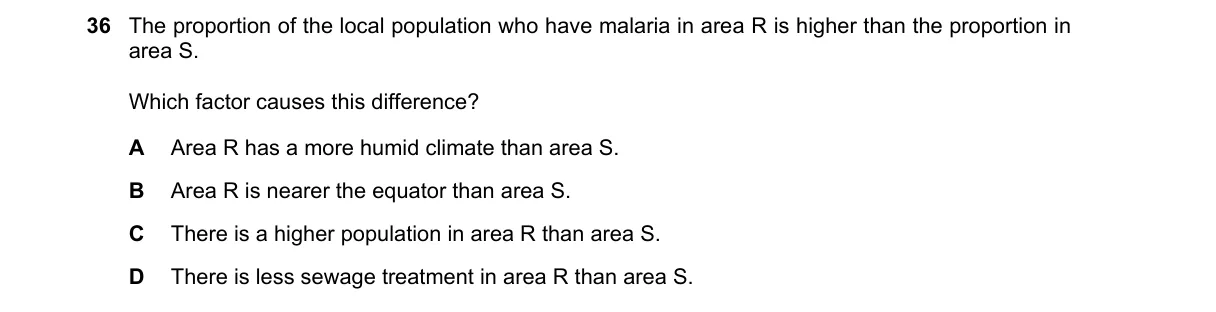
Answer choices
- AArea R has more humid climate than area S.
- BArea R is nearer the equator than area S.
- CThere is higher population in area R than area S.
- DThere is less sewage treatment in area R than area S.
Explanation
Malaria thrives in humid conditions favoring mosquito breeding
Steps:
- Identify malaria as a disease transmitted by Anopheles mosquitoes, which require standing water for breeding.
- Recognize that humidity affects mosquito survival and reproduction rates.
- Compare areas: Higher humidity in R supports more mosquitoes, increasing infection proportion.
- Eliminate unrelated factors like population density or sewage, which don't directly influence malaria vectors.
Why A is correct:
- Mosquitoes breed in stagnant water, and higher humidity in R prevents evaporation, creating ideal conditions for larvae development per vector biology principles.
Why the others are wrong:
- B: Proximity to equator correlates with warmth but not directly with humidity or breeding sites.
- C: Higher population increases total cases but not the proportion (prevalence rate) without vector influence.
- D: Sewage relates to bacterial diseases like cholera, not mosquito-borne malaria.
Final answer: A
Topic: Infectious diseases
Practice more A Levels Biology (9700) questions on mMCQ.me