A Levels Biology (9700)•9700/11/O/N/20
A Levels Biology (9700) — 9700/11/O/N/20, Question 32
What is correct about transport of carbon dioxide by blood? 1. The enzyme carbonic anhydrase catalyses the formation of carbonic acid in red blood cells. 2. Carbon dioxide diffuses from active tissues to red blood cells and reacts with water. 3. Carbonic acid dissociates forming hydrogen ions that combine with haemoglobin to form carbaminohemoglobin.
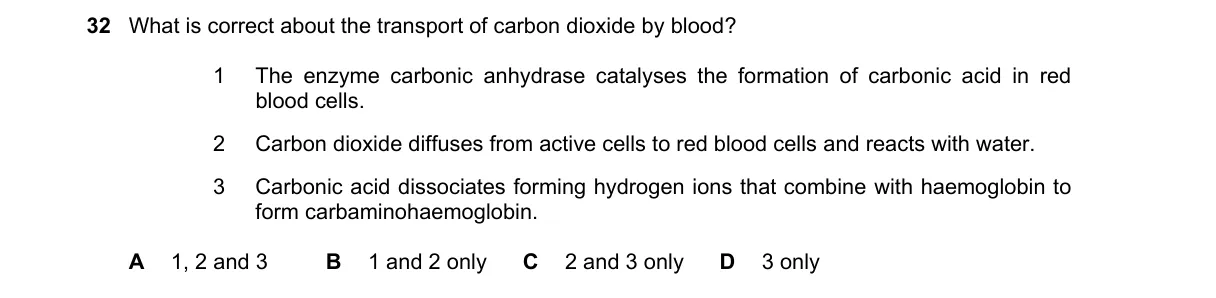
Answer choices
- A1,2 and 3
- B1 and 2
- C2 and 3
- D3 only
Explanation
CO2 Transport in Blood via Bicarbonate
Steps:
- CO2 from tissues diffuses into blood plasma and RBCs.
- In RBCs, CO2 reacts with H2O to form H2CO3, catalyzed by carbonic anhydrase.
- H2CO3 dissociates into H+ and HCO3-; H+ binds to Hb to buffer pH, while HCO3- exits RBCs via chloride shift.
- Separate process: Some CO2 binds directly to Hb amino groups forming carbaminohemoglobin, without H+ involvement.
Why B is correct:
- Statements 1 and 2 accurately describe carbonic anhydrase catalyzing CO2 + H2O → H2CO3 in RBCs for bicarbonate formation, per standard physiology.
Why the others are wrong:
- A includes 3, but H+ from H2CO3 binds Hb as HHb, not forming carbaminohemoglobin (which is direct CO2-Hb binding).
- C includes 3, which misattributes carbaminohemoglobin formation to H+.
- D relies only on incorrect statement 3.
Final answer: B
Topic: Transport of oxygen and carbon dioxide
Practice more A Levels Biology (9700) questions on mMCQ.me