A Levels Biology (9700)•9700/11/O/N/20
A Levels Biology (9700) — 9700/11/O/N/20, Question 12
Which properties of water reduce temperature changes inside cells?
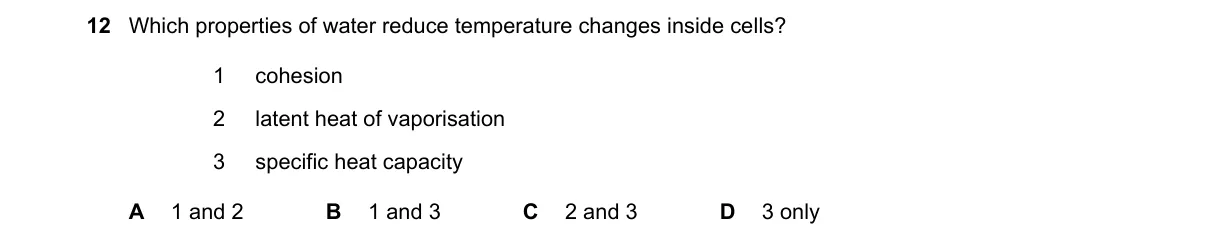
Answer choices
- A1 and 2
- B1 and 3
- C2 and 3
- D3 only
Explanation
Water's High Specific Heat Capacity Stabilizes Cellular Temperatures
Steps:
- Identify properties of water relevant to temperature regulation: cohesion (1), polarity/solvent ability (2), high specific heat capacity (3).
- Recall that temperature changes in cells are minimized by resistance to heat absorption or loss.
- Evaluate each: cohesion aids transport but not temperature buffering; solvent dissolves substances but doesn't directly affect heat; specific heat capacity requires more energy to change temperature.
- Conclude only property 3 directly reduces temperature fluctuations inside cells.
Why D is correct:
- High specific heat capacity means water absorbs/releases large amounts of heat with minimal temperature change, per the formula , where high (4.18 J/g°C) buffers cellular environments.
Why the others are wrong:
- A includes 1 (cohesion) and 2 (solvent), which support structure and reactions but not thermal stability.
- B includes 1 (cohesion), irrelevant to temperature buffering.
- C includes 2 (solvent), which aids biochemistry but doesn't resist heat-induced temperature shifts.
Final answer: D
Topic: Water
Practice more A Levels Biology (9700) questions on mMCQ.me