A Levels Biology (9700)•9700/13/O/N/19
A Levels Biology (9700) — 9700/13/O/N/19, Question 9
Three proteins that have quaternary structure are listed • Type I collagen is formed from three different polymers. • The main form of hemoglobin contains two alpha globins and two beta globins. • HIV protease consists of two identical polymers. Which row shows the correct number of genes needed to code for each protein?
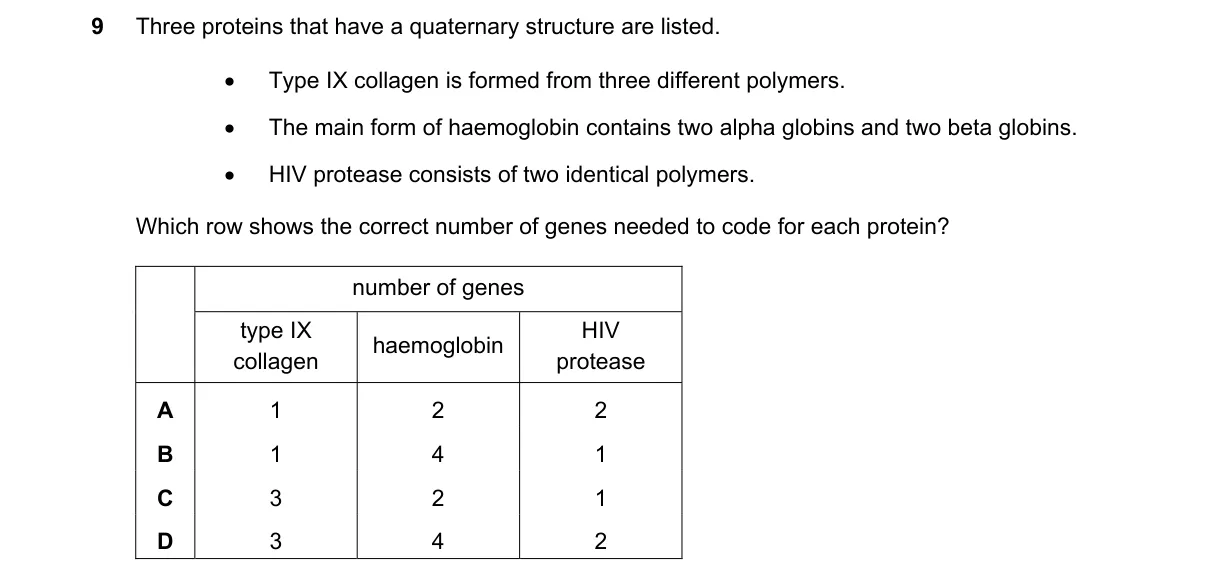
Answer choices
- A1 2 2
- B3 4 1
- C1 4 1
- D3 4 2
Explanation
Ambiguous description of protein structures prevents clear choice
Steps:
- Review each protein's description and match to biological fact: genes code for distinct polypeptide types in quaternary structures.
- Type I collagen: Description says "three different polymers," but actually uses two types (α1 and α2 chains), requiring 2 genes; ambiguity in "different."
- Hemoglobin: Two types (α and β globins), requiring 2 genes, despite four total chains.
- HIV protease: One type (identical subunits), requiring 1 gene.
- Overall: Expected row is 2 2 1, not listed; description conflicts with facts.
Why C is correct:
- Not enough information; C (1 4 1) mismatches facts (collagen ≠1 gene, hemoglobin ≠4 genes).
Why the others are wrong:
- A: Underestimates all (collagen ≠1, hemoglobin=2, HIV=1).
- B: Overestimates hemoglobin as 4 chains instead of 2 types; collagen possibly 3 per description but factually 2.
- D: Overestimates HIV as 2 instead of 1 type.
Final answer: Not enough information.
Topic: Proteins
Practice more A Levels Biology (9700) questions on mMCQ.me