A Levels Biology (9700)•9700/13/O/N/19
A Levels Biology (9700) — 9700/13/O/N/19, Question 36
The statements refer to tuberculosis (TB). 1 The pathogen lives inside human cells so is not accessible to the immune system. 2 The bacterial pathogen reproduces slowly. 3 The pathogen is not sensitive to antibiotics. Which explains why antibiotic treatment for TB takes a long time?
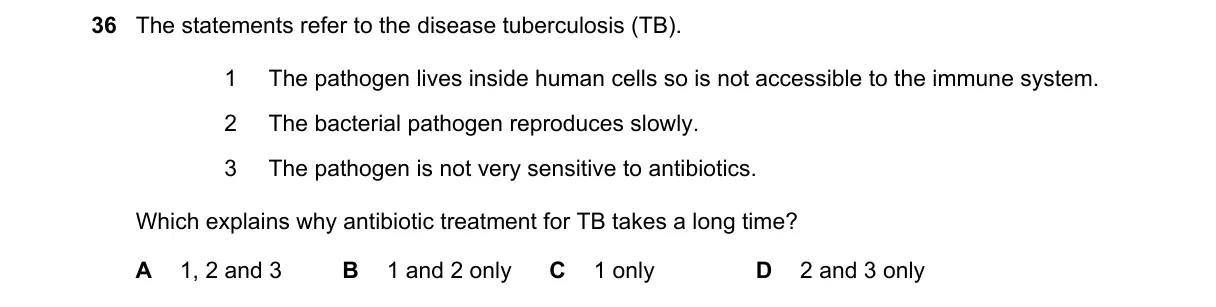
Answer choices
- A1, 2 and 3
- B1 and 2
- C1 only
- D2 and 3 only
Explanation
Factors Prolonging TB Antibiotic Treatment
Steps:
- Evaluate statement 1: It describes immune evasion inside cells, which affects host response but not direct antibiotic access or treatment duration.
- Evaluate statement 2: Slow bacterial reproduction (Mycobacterium tuberculosis doubles every 15-24 hours) requires extended antibiotic exposure to fully eradicate the population.
- Evaluate statement 3: The pathogen's low sensitivity and potential resistance to antibiotics necessitate prolonged, multi-drug regimens to prevent relapse.
- Combine relevant factors: Statements 2 and 3 directly explain why treatment lasts 6-9 months, while 1 does not.
Why D is correct:
- TB's slow replication and intrinsic resistance (due to thick cell wall and efflux pumps) demand long-term therapy to achieve bactericidal effects, per standard WHO guidelines.
Why the others are wrong:
- A: Includes irrelevant statement 1 about immune accessibility.
- B: Omits statement 3 on antibiotic sensitivity, a key driver of treatment length.
- C: Relies solely on statement 1, which pertains to immunity, not antibiotics.
Final answer: D
Topic: Antibiotics
Practice more A Levels Biology (9700) questions on mMCQ.me