A Levels Biology (9700)•9700/13/O/N/19
A Levels Biology (9700) — 9700/13/O/N/19, Question 31
Red cells may contain a molecule known as 2,3-bisphosphoglycerate (2,3-BPG). When 2,3-BPG binds to hemoglobin, a higher partial pressure of oxygen is needed to bring about 50% saturation of hemoglobin with oxygen. Which statements about the effect of 2,3-BPG are correct? 1. 2,3-BPG in red cells causes the oxygen dissociation curve to shift to the right. 2. The binding of 2,3-BPG to hemoglobin reduces the affinity of the hemoglobin for oxygen. 3. When 2,3-BPG is absent, oxyhemoglobin is less likely to unload oxygen.
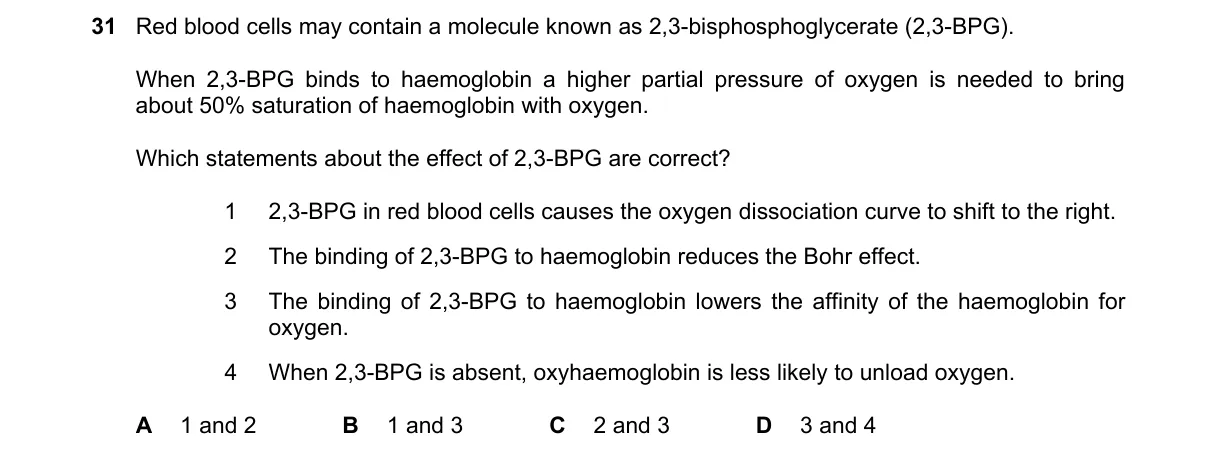
Answer choices
- A1 and 2
- B1 and 3
- C2 and 3
- D3 and 4
Explanation
2,3-BPG Shifts Oxygen Dissociation Curve Rightward
Steps:
- 2,3-BPG binds deoxyhemoglobin, stabilizing low-affinity T-state and increasing P50 (PO2 for 50% saturation).
- Statement 1 correct: right shift requires higher PO2 for 50% saturation, matching question description.
- Statement 2 incorrect: 2,3-BPG binds only deoxyhemoglobin, not reducing affinity of oxyhemoglobin directly.
- Statement 3 correct: absent 2,3-BPG causes left shift, raising oxygen affinity so oxyhemoglobin holds O2 tighter in tissues.
Why B is correct:
- Combines accurate descriptions of curve shift (1) and unloading effect without BPG (3), per oxygen-hemoglobin dissociation principles.
Why the others are wrong:
- A includes incorrect statement 2 on binding-affinity link.
- C pairs incorrect 2 with correct 3.
- D references nonexistent statement 4.
Final answer: B
Topic: Transport of oxygen and carbon dioxide
Practice more A Levels Biology (9700) questions on mMCQ.me