A Levels Biology (9700)•9700/13/O/N/19
A Levels Biology (9700) — 9700/13/O/N/19, Question 27
Which xerophytic adaptations reduce the water potential gradient between leaf surface and atmosphere? 1 rolled leaves 2 hairy leaves 3 sunken stomata 4 fleshy leaves
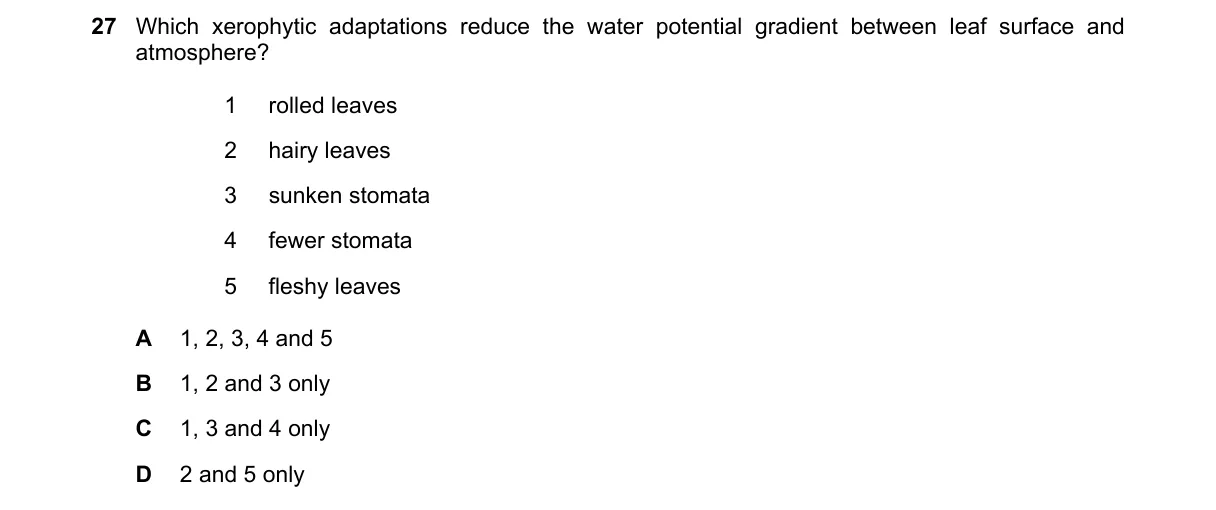
Answer choices
- A1,2 and 3 only
- B1,2 and 4 only
- C1,3 and 4 only
- D2 and 4 only
Explanation
Xerophytic adaptations minimizing transpiration by reducing water potential gradient
Steps:
- Water potential gradient (ψ_leaf - ψ_atm) drives transpiration; reducing it slows water loss by increasing air humidity near leaf or maintaining high leaf ψ.
- Rolled leaves trap humid air inside, raising local ψ_atm and reducing gradient.
- Hairy leaves create a moist boundary layer via trapped water vapor, decreasing ψ difference.
- Fleshy leaves store water, sustaining high ψ_leaf to lessen overall gradient.
- Sunken stomata increase diffusion resistance but do not directly alter humidity or leaf ψ.
Why B is correct:
- Option B includes rolled leaves, hairy leaves, and fleshy leaves, which directly reduce the gradient per Fick's law of diffusion (rate ∝ Δψ / resistance), focusing on Δψ minimization.
Why the others are wrong:
- A includes sunken stomata, which mainly boosts resistance, not gradient reduction.
- C excludes hairy leaves, missing a key humidity-trapping adaptation.
- D omits rolled leaves, ignoring enclosure of moist air.
Final answer: B
Topic: Transport mechanisms
Practice more A Levels Biology (9700) questions on mMCQ.me