A Levels Biology (9700)•9700/13/O/N/19
A Levels Biology (9700) — 9700/13/O/N/19, Question 11
Some extracellular protease enzymes are synthesised in an inactive form called zymogen. Zymogen is converted to active protease in the Golgi body. What is the purpose of producing zymogen before converting it to extracellular protease?
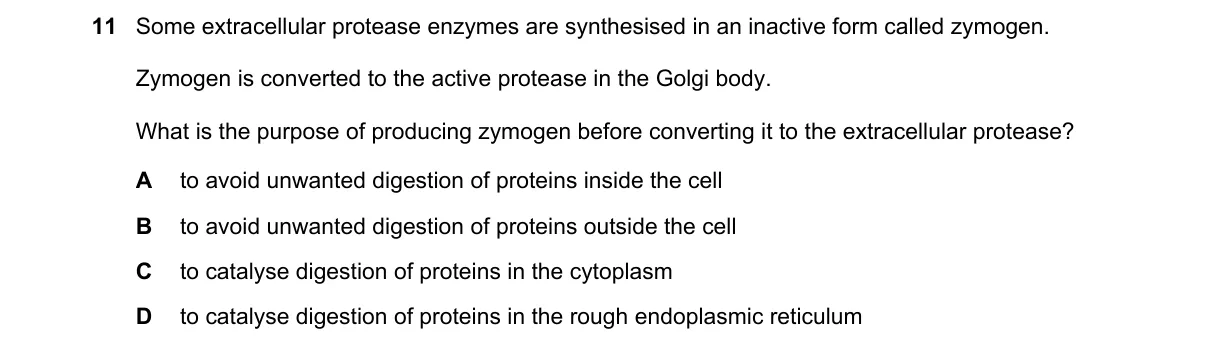
Answer choices
- Ato avoid unwanted digestion of proteins inside the cell
- Bto avoid unwanted digestion of proteins outside the cell
- Cto catalyse digestion of proteins in the cytoplasm
- Dto catalyse digestion of proteins in the rough endoplasmic reticulum
Explanation
Zymogens protect cells from self-digestion
Steps:
- Proteases are enzymes that break down proteins, so active forms could damage cellular structures.
- Zymogens are inactive precursors synthesized in the rough ER and processed in the Golgi.
- Activation occurs just before secretion, ensuring the enzyme is inactive inside the cell.
- This prevents accidental protein degradation during synthesis and transport.
Why A is correct:
- Zymogens inactivate proteases intracellularly, avoiding autolysis as per enzyme regulation principles in cell biology.
Why the others are wrong:
- B: Activation happens inside the cell; outside, the enzyme targets specific substrates, not avoiding digestion broadly.
- C: Proteases are for extracellular digestion, not cytoplasmic, which would harm the cell.
- D: Rough ER synthesizes zymogens, but they remain inactive there to prevent damage, not to catalyze.
Final answer: A
Topic: Mode of action of enzymes
Practice more A Levels Biology (9700) questions on mMCQ.me