A Levels Biology (9700)•9700/12/O/N/19
A Levels Biology (9700) — 9700/12/O/N/19, Question 38
Immune response to a vaccination against a virus can be assessed by making three measurements: 1: the concentration of anti-virus antibody in the blood 2 the time taken to increase the antibody concentration significantly after a booster 3 the number of virus-specific lymphocytes per cm blood. What describes the immunity of an individual when values of 1,2 and 3 are all low ten years after vaccination?
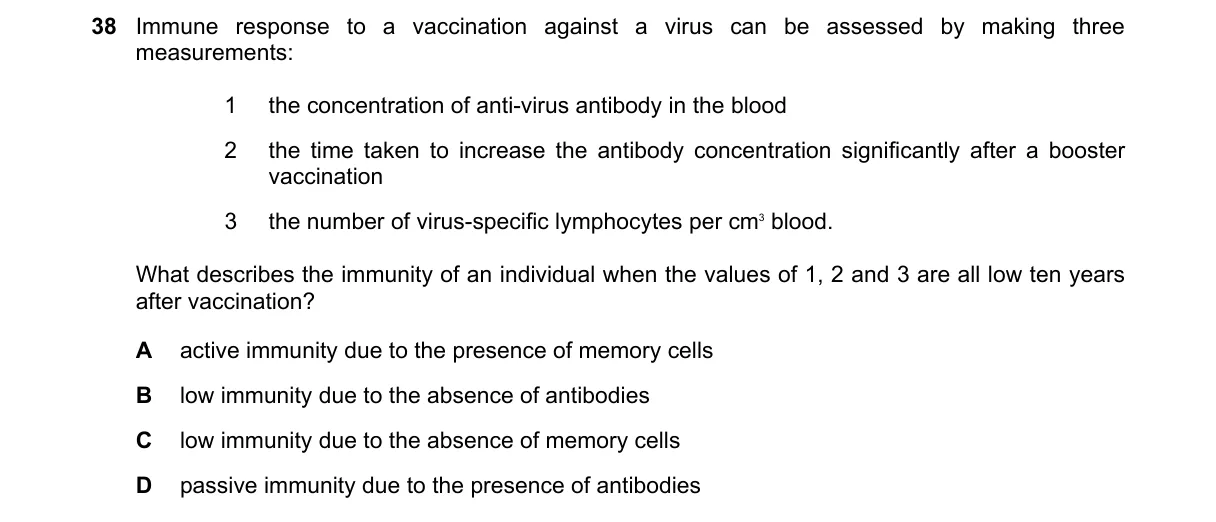
Answer choices
- Alow immunity due to the presence of memory cells
- Blow immunity due to the absence of antibodies
- Clow immunity due to the absence of memory cells
- Dpassive immunity due to the presence of antibodies
Explanation
Waning active immunity despite memory cell presence
Steps:
- Low antibody concentration (1) shows no circulating antibodies for immediate defense, indicating low active humoral immunity.
- Low time to antibody increase after booster (2) means rapid secondary response, confirming functional memory cells.
- Low virus-specific lymphocytes (3) reflects few circulating effectors or naive cells, but does not rule out tissue-resident memory.
- Overall, current protection is low ten years post-vaccination, but memory enables quick reactivation.
Why A is correct:
- Memory cells provide latent immunity; their presence explains rapid boosting despite low current antibodies and lymphocytes, defining low active immunity.
Why the others are wrong:
- B: Ignores rapid booster response, which indicates memory beyond just antibody absence.
- C: Contradicts low booster time, as absent memory would delay response significantly.
- D: Vaccination induces active, not passive, immunity; antibodies are low, not present from external source.
Final answer: A
Topic: Antibodies and vaccination
Practice more A Levels Biology (9700) questions on mMCQ.me