A Levels Biology (9700)•9700/12/O/N/19
A Levels Biology (9700) — 9700/12/O/N/19, Question 37
Different antibiotics function in different ways. It is important that the antibiotic kills the bacteria, but does not harm the infected human. The antibiotic tetracycline has been found to affect the way in which human mitochondria function. Which statements could explain why mitochondria function is affected by tetracycline?
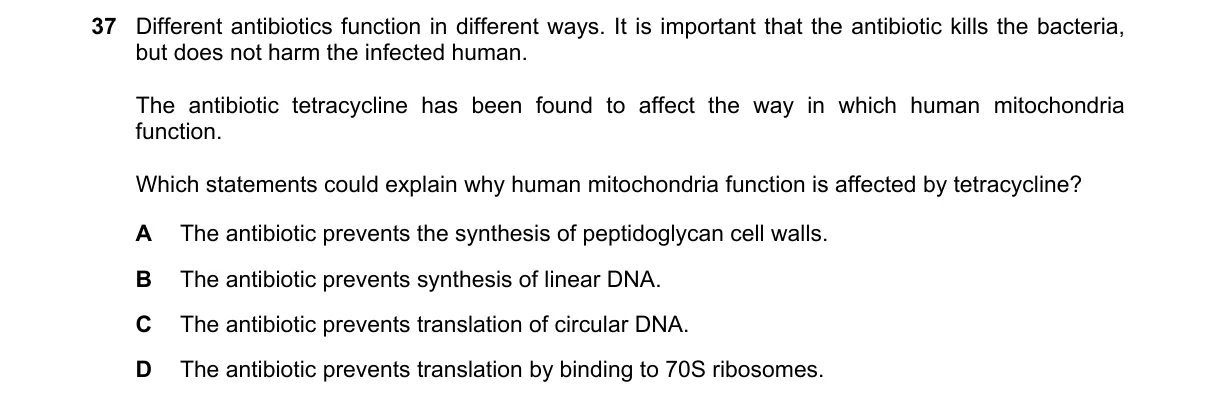
Answer choices
- AThe antibiotic prevents the synthesis of linear DNA cell walls.
- BThe antibiotic prevents translation of circular DNA.
- CThe antibiotic prevents translation by binding to 70S ribosomes.
- DThe antibiotic prevents translation by binding to 70S ribosomes.
Explanation
Tetracycline Targets Bacterial-Like Mitochondrial Ribosomes
Steps:
- Mitochondria evolved from bacteria, featuring circular DNA and 70S ribosomes similar to prokaryotes.
- Tetracycline inhibits protein synthesis by binding to the 30S subunit of 70S ribosomes, preventing translation.
- Human cytoplasmic ribosomes are 80S and unaffected, but mitochondrial 70S ribosomes are targeted.
- Options are evaluated based on tetracycline's mechanism and mitochondrial features.
Why D is correct:
- Tetracycline binds specifically to 70S ribosomes, inhibiting translation; mitochondria contain 70S ribosomes, explaining the functional disruption.
Why the others are wrong:
- A: Cell walls are peptidoglycan structures, not DNA-based; tetracycline does not target wall synthesis.
- B: Translation decodes mRNA, not DNA; circular DNA relates to replication, not translation.
- C: Identical to D, but lacks specificity on mitochondrial 70S ribosomes.
Final answer: D
Topic: Antibiotics
Practice more A Levels Biology (9700) questions on mMCQ.me