A Levels Biology (9700)•9700/12/O/N/19
A Levels Biology (9700) — 9700/12/O/N/19, Question 2
The diameter of living cells varies considerably. The diameter of a typical eukaryotic cell is 1.5 × 10 μm. The diameter of a typical prokaryotic cell is 7.5 × 10 nm. Using these measures, what is the maximum number of each type which could fit along a 1 cm line?
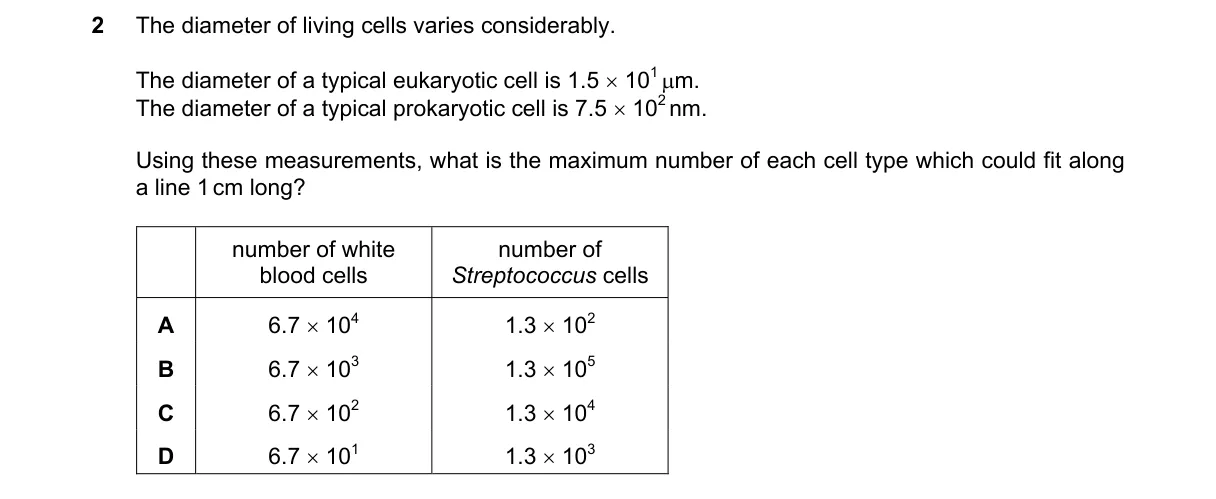
Answer choices
- A6.7 × 10^ , 1.3 × 10^ Streptococcus cells
- B6.7 × 10^2 , 1.3 × 10^
- C6.7 × 10^3 , 1.3 × 10^3
- D6.7 × 10^4 , 1.3 × 10^4
Explanation
Unit Conversion and Division for Cell Count Steps:
- Convert line length to micrometers: 1 cm = 10,000 μm = 10^4 μm.
- Eukaryotic cell diameter = 1.5 μm; maximum number = 10^4 μm / 1.5 μm ≈ 6,667 = 6.7 × 10^3 cells.
- Prokaryotic cell diameter = 7.5 μm; maximum number = 10^4 μm / 7.5 μm ≈ 1,333 = 1.3 × 10^3 cells. Why C is correct:
- Matches the calculated counts using consistent μm units and simple division for linear fit. Why the others are wrong:
- A: Incomplete exponents; does not specify full values.
- B: Underestimates both by factor of 10, likely from incorrect diameter (e.g., 15 μm and 75 μm).
- D: Overestimates both by factor of 10, likely from unit error (e.g., treating as nm without conversion).
Final answer: C
Topic: Cells as the basic units of living organisms
Practice more A Levels Biology (9700) questions on mMCQ.me